
Canada’s Water Monsters: Ogopogo, Caddy, Memphré, and the Mystery Beneath the Surface
Canada is full of enormous lakes, long stretches of cold coastline, forested shorelines, hidden bays, and water deep enough to make almost anyone wonder what might be below. Add a few strange sightings, an old story, a blurry photograph, and a creature can become part of a place forever.
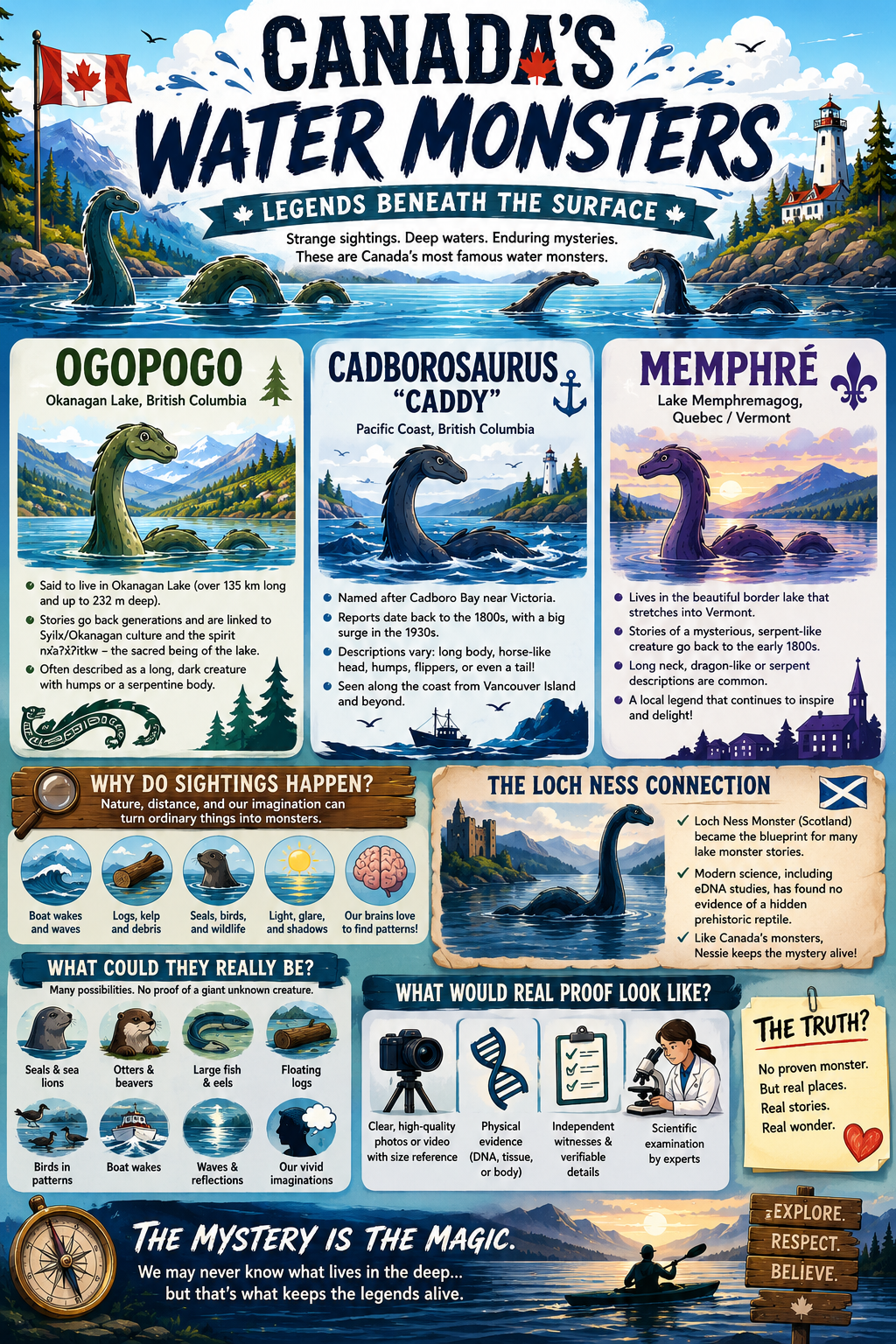
That is how Canada ended up with legends like Ogopogo in British Columbia’s Okanagan Lake, Cadborosaurus—or “Caddy”—along the Pacific Coast, and Memphré in Lake Memphremagog near Magog, Quebec. None has been confirmed as a real unknown animal, but all three have survived because the places connected to them already feel mysterious.
They are not exactly the same kind of legend. Ogopogo is tied to a deeper Indigenous cultural tradition that deserves more respect than a simple monster-hunt story. Caddy is a coastal sea-serpent mystery, not a lake monster. Memphré is a classic long-necked creature story attached to a deep, beautiful border lake. Together, though, they show why humans keep seeing monsters in wild water.
Quick Answer: Are Canada’s Water Monsters Real?
No Canadian water monster has been proven to be a previously unknown species. There is no accepted body, clear biological sample, repeated high-quality video, or scientific evidence showing that Ogopogo, Caddy, or Memphré is a giant hidden animal.
That does not mean every witness is lying. Most sightings are probably sincere attempts to describe something unusual seen briefly, at a distance, in difficult conditions. Water, waves, weather, low light, floating debris, known animals, and human expectation can all turn a strange moment into a monster story.
The real appeal is not only whether the creatures exist. It is that each legend gives its lake or coastline a personality. A place with a monster feels deeper, wilder, and less completely explained.
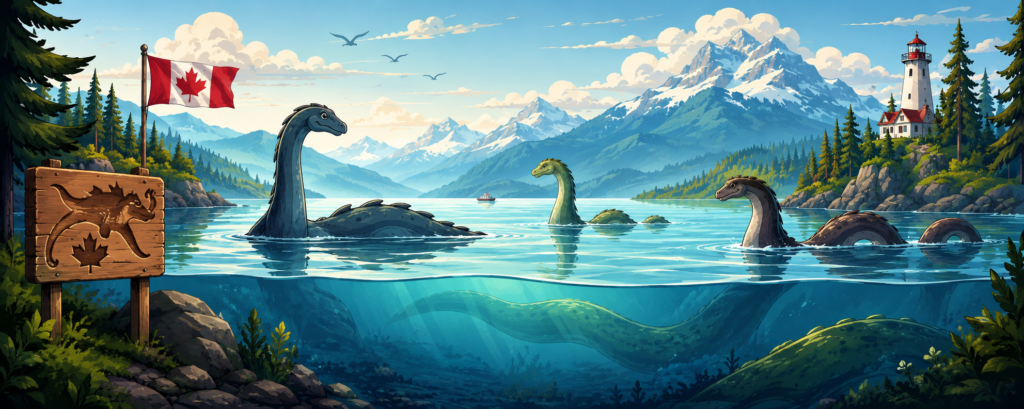
Ogopogo and Okanagan Lake: More Than a Monster Story
The most famous Canadian lake monster is Ogopogo, said to live in Okanagan Lake in British Columbia. Popular descriptions usually show a long, dark, serpent-like creature with humps rising from the water, sometimes compared to a giant eel, a sea serpent, or a surviving prehistoric reptile.
Okanagan Lake is exactly the sort of place where a legend can take hold. It is long, deep, cold, and surrounded by steep terrain, vineyards, towns, and mountain views. From shore, the lake can look calm and welcoming one moment, then dark, wind-blown, and enormous the next.
But there is an important correction worth making. The popular Ogopogo image is not the same thing as the Syilx understanding of nx̌aʔx̌ʔitkʷ, a sacred spirit connected to Okanagan Lake. For the Syilx/Okanagan people, the lake is not simply a backdrop for a tourist monster story. It is a place of responsibility, respect, memory, and relationship.
That distinction matters. The fun, commercial version of Ogopogo—with souvenir shops, cartoons, monster hunts, and sightings—is part of modern regional folklore. But it should not erase or flatten the deeper cultural meaning of the lake.
Why Okanagan Lake Creates So Many Monster-Like Moments
Large lakes can create strange visual effects. A line of waves moving toward shore can look like several humps travelling in sequence. A floating log can seem much larger than it is when there is no clear object nearby for scale. A bird, beaver, otter, or swimmer may only be visible in fragments, leaving the observer to fill in the rest.
On windy days, Okanagan Lake can produce choppy, irregular surface patterns that make a dark object appear and disappear. In the distance, the lower part of an object can be hidden by waves while only the top remains visible. That is exactly the kind of view that can create the classic “head and humps” monster shape.
Still, the legend survives because people want to believe there may be something more. A lake with a story feels more alive than a lake that is only measured in depth, shoreline, and boating rules.
Cadborosaurus: Canada’s Pacific Sea Serpent
Cadborosaurus is different from Ogopogo because it is supposed to live in saltwater, not a lake. The name comes from Cadboro Bay near Victoria, British Columbia, although reports connected to “Caddy” have been made across parts of the British Columbia coast and the wider Pacific Northwest.
Witnesses have described Caddy in many different ways. Some reports describe a long body with humps. Others mention a horse-like or camel-like head, flippers, a tail, or a snake-like swimming motion. That variety is part of what makes the story interesting—and part of what makes it difficult to treat as evidence for one single animal.
Caddy became especially well known in the 1930s, around the same time Loch Ness Monster stories were exploding in newspapers overseas. Once the public had a familiar image of a long-necked water monster in mind, people were more likely to interpret unfamiliar sights through that same lens.
What Could Caddy Actually Be?
British Columbia’s coast contains a lot of real wildlife that can look strange under the right conditions. A person seeing only a few seconds of movement from far away may be looking at a seal, sea lion, group of porpoises, whale, shark, large fish, floating kelp, or several animals moving in a line.
A group of swimming sea lions can create a surprisingly monster-like silhouette. Their heads may appear one after another above the surface, producing the illusion of a long animal with humps. A large log rolling in waves can also seem alive, especially when the observer only catches it between swells.
The ocean is also much harder to search than people realize. It is vast, deep, dark, and constantly moving. That gives Caddy more room to remain mysterious than a lake monster—but it does not prove that a giant undiscovered reptile is living off the coast.
The most reasonable conclusion is that “Caddy” may be a collection of different sightings rather than one hidden species. That does not make the story boring. It actually makes it more human: generations of people noticing something odd at sea and giving it a shared name.
Memphré of Lake Memphremagog
Lake Memphremagog sits along the Quebec–Vermont border, with Magog, Quebec at its northern end. It is long, narrow in places, surrounded by hills and mountains, and large enough to feel much bigger once you are out on open water.
The creature associated with the lake is known as Memphré, usually described as a serpent-like animal or long-bodied monster. Some accounts describe something like a dragon, while others sound closer to the classic Loch Ness image: a long neck, a head above water, and a body mostly hidden below the surface.
Local folklore traces monster stories in the lake back a long way, including reports said to date to the early 1800s. Whether every detail of those old stories can be verified is less important than the fact that Memphré became part of the area’s identity. The creature is now woven into local tourism, boat tours, books, souvenirs, and regional storytelling.
Why Lake Memphremagog Feels Like the Perfect Monster Lake
Memphremagog is visually made for legend. It crosses an international border, has deep sections, mountain backdrops, irregular shorelines, islands, changing weather, and long open views where distance is difficult to judge.
A dark object in rough water can look huge when there is no boat, dock, or shoreline close enough to compare it against. Human eyes are not good at estimating size over water, particularly during fog, rain, sunset, or changing light.
The lake also has plenty of ordinary wildlife, boats, floating debris, wakes, and wave patterns that can create quick, convincing illusions. A creature does not have to be present for someone to have a real and unsettling experience. A person can sincerely see something they cannot immediately explain.
The Loch Ness Monster Connection
Loch Ness in Scotland is the global blueprint for almost every modern lake-monster story. Nessie became internationally famous in the 1930s, and the familiar image of a long neck rising from dark water has influenced monster reports ever since.
That does not mean Ogopogo, Caddy, and Memphré were invented because of Nessie. Local stories and regional traditions existed independently. But Nessie gave newspapers, tourists, witnesses, and artists a shared visual language: dark water, a strange wake, a distant head, and the thrilling possibility of an animal science has missed.
The comparison is useful because Loch Ness has also received far more scientific attention than most monster locations. Researchers have used sonar, underwater cameras, eyewitness databases, and environmental DNA sampling in attempts to find unusual large animals.
Environmental DNA, or eDNA, is especially interesting. Animals shed tiny traces of genetic material into water through skin cells, waste, mucus, and other biological material. A major Loch Ness study found no evidence supporting the popular idea of a hidden plesiosaur or giant prehistoric reptile, though it did detect plenty of eel DNA.
That does not prove every sighting was an eel. It does show what a real scientific search looks like: collecting samples, comparing them to known species, and looking for evidence that can be independently checked.
Why Are the Photos Always Blurry?
This is the question that every lake-monster story eventually faces. Almost everyone carries a phone with a camera now, so why has no one captured a perfect image?
The honest answer is that photographing anything far away on water is difficult. A phone camera can make a distant object look tiny, shaky, grainy, and flattened. Digital zoom often makes the image worse rather than better, especially in low light or when the subject is moving.
There are several reasons monster photos rarely settle the question:
- Water hides most of an object below the surface.
- Waves can break one object into several visible “humps.”
- Distance is hard to judge without a known object for scale.
- Wind, glare, fog, rain, and sunset reduce detail.
- Witnesses often have only a few seconds before the object disappears.
- Phones struggle to focus on moving subjects across long distances.
- People naturally interpret vague shapes based on what they expect or fear.
A photograph can be interesting without being strong evidence. The difference is whether another person can independently examine the original file, location, lighting, angle, distance, and possible natural explanation.
The Most Likely Explanations
Most water-monster sightings probably do not have one single answer. A strange-looking event can come from several ordinary causes working together.
A large wake may travel far from the boat that created it. A log can roll, dip, and rise in a way that resembles an animal swimming. A group of birds or marine mammals can appear to be one long creature. A person’s brain may connect separate wave crests into a body because humans are built to recognize patterns quickly.
Possible explanations often include:
- Boat wakes travelling across open water
- Floating logs, driftwood, kelp, or debris
- Seals, sea lions, otters, beavers, or diving birds
- Groups of animals moving in sequence
- Waves, reflections, shadows, and wind patterns
- Large fish or eels seen briefly
- Misjudged distance or size
- Deliberate hoaxes or edited footage
The dull answer is not always the correct answer, though. “Probably a wake” is not the same as “definitely a wake.” That small space between likely explanation and total certainty is where legends survive.
What Would Real Proof Look Like?
A convincing discovery would need more than a blurry image or a single witness report. It would require evidence that other people could examine and test.
The strongest evidence would likely include a clear, continuous high-resolution video showing the animal with a reliable size reference, such as a boat, shoreline marker, or known object. Independent witnesses, exact location data, original files, and environmental conditions would also matter.
Even better would be biological evidence. Repeated DNA samples from the same unknown animal, a verified tissue sample, a body, or a living specimen documented by qualified researchers would change the conversation immediately.
Until then, Ogopogo, Caddy, Memphré, and Nessie remain legends—not because people should be mocked for telling the stories, but because extraordinary claims need evidence strong enough to survive close examination.
The Real Reason These Monsters Matter
Water monsters are really stories about place. They are a way of saying that a lake is more than water on a map, or that a coastline still has room for surprise.
Ogopogo makes Okanagan Lake feel older and stranger than a beautiful vacation destination. Caddy makes the cold Pacific Coast feel vast and unknowable. Memphré adds mystery to a border lake that already feels tucked between two worlds. Nessie turned a Scottish loch into one of the most recognizable bodies of water on Earth.
Maybe there is no giant serpent below the waves. But there is something real in these legends: the feeling of standing beside dark water, looking into the distance, and realizing how much of the world remains outside your view.
That is enough to keep people watching the surface.
Related External Links
Spirit of the Lake: nx̌aʔx̌ʔitkʷ and Okanagan Lake — Learn about the Syilx cultural understanding of the sacred spirit associated with Okanagan Lake.
University of Otago: First eDNA Study of Loch Ness — Explore how scientists used environmental DNA to investigate what lives in Loch Ness.