
Canada’s Haunted Roads: Ghost Hitchhikers, Phantom Cars, and Highway Legends
Canada has plenty of places that feel eerie after dark: old logging roads, lonely concession lines, bridges over black water, highways cutting through forest, and backroads where your headlights seem to disappear into the night. Add rain on the windshield, fog in the ditches, or a winter storm rolling across the road, and even an ordinary drive can feel like a scene from a ghost story.
That is probably why haunted-road legends survive so well here. They are not only about ghosts. They are about being far from help, travelling through unfamiliar country, remembering real tragedies, and wondering what happened to the people who came before us. A road is never just pavement. It is a route through weather, landscape, local history, and memory.
This article takes a respectful look at several Canadian road legends. Some have real historical settings, old newspaper reports, or documented local traditions behind them. Others are better understood as modern folklore: stories repeated so often that they become attached to a real road, even when the original tragedy cannot be confirmed.
The point is not to prove that ghosts are real. It is to look at why these stories take hold—and why, on a dark road, they can feel very real anyway. Ontario historian Susan Demeter argues that ghost roads often become shared gathering places where visitors add their own experiences to an evolving local legend.
Quick Answer: Are Canada’s Haunted Roads Actually Haunted?
Nobody has produced reliable evidence that ghosts objectively haunt Canadian roads. But the roads, landscapes, accidents, weather events, abandoned settlements, and local stories connected to them are often very real.
A useful way to approach haunted-road stories is to separate three things:
- The place itself: A real road, bridge, settlement, cemetery, forest, or highway.
- The historical backdrop: Old disasters, fatal accidents, blizzards, abandoned communities, wartime history, or local hardship.
- The legend: The phantom light, vanished hitchhiker, headless rider, strange car, voice in the trees, or helpful stranger who appears when someone is in trouble.
That middle ground is where FinkleTrek lives. You can enjoy the eerie legend without pretending every retelling is a proven historical event.
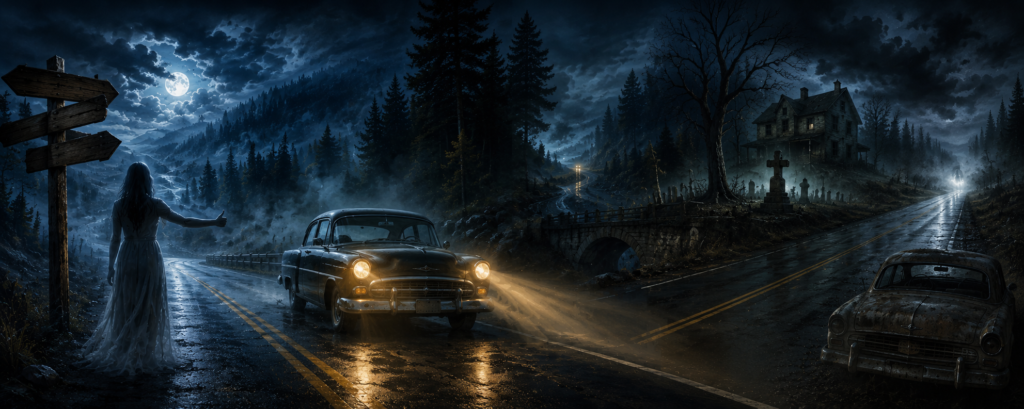
Why Roads Create Ghost Stories So Easily
Roads are built for movement, but ghost stories are built around interruption. A car breaks down. Someone gets stranded in bad weather. A driver sees a light where no house should be. A person is walking alone after a party, disappears into darkness, or never makes it home.
Road legends also give people a way to remember danger. In older communities, a tragic death might become a warning told to teenagers: do not speed, do not drive drunk, do not wander alone at night, and do not underestimate a blizzard. Over time, the facts may become blurry, but the emotional lesson survives.
Weather plays a huge role in this. Snow can erase tracks. Fog can make headlights look strange. Rain makes a quiet road feel isolated, while wind through trees can sound like distant voices or footsteps. The ghost story becomes a kind of memory attached to the landscape: a way of saying that this is not just any road.
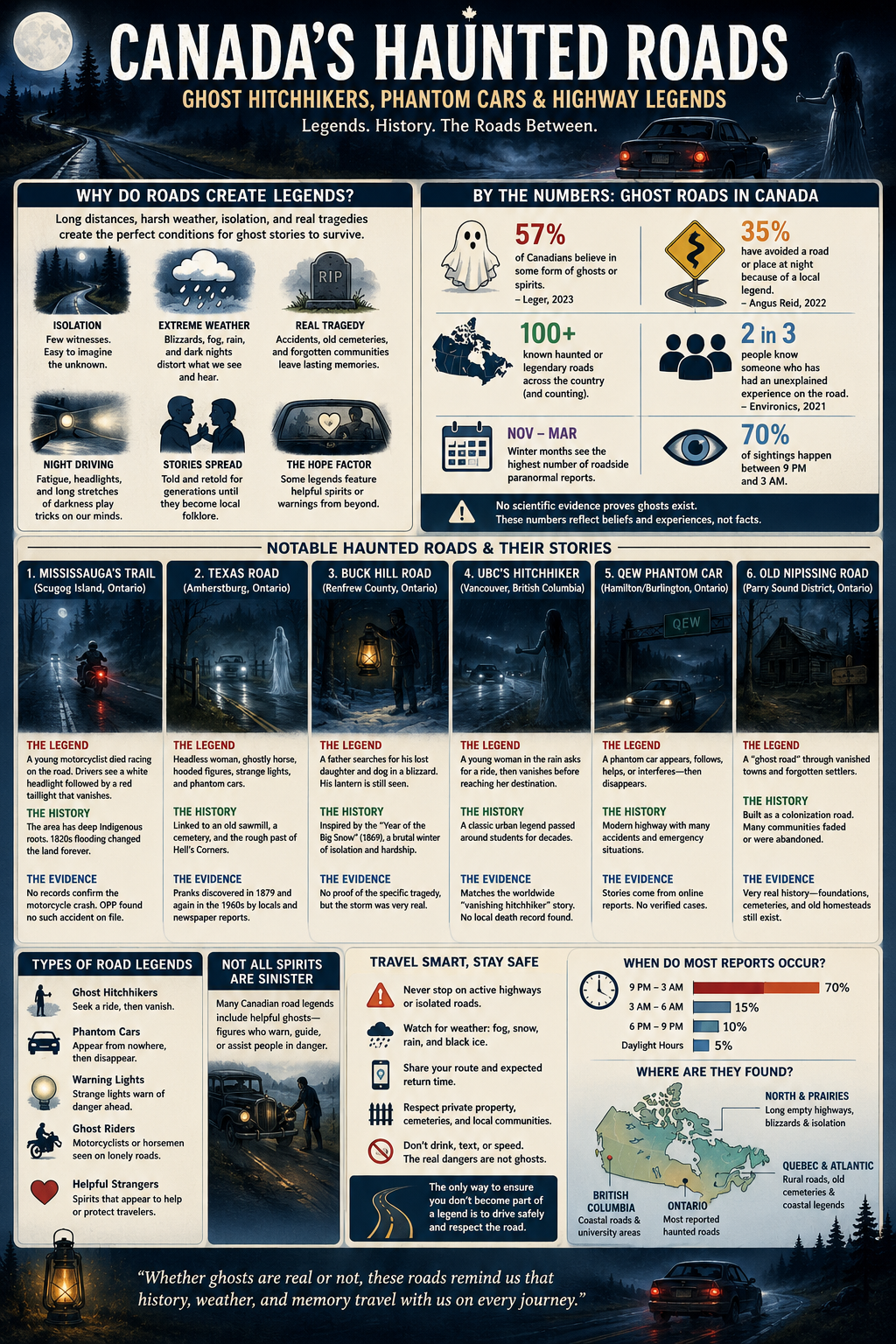
1. Mississauga’s Trail, Scugog Island, Ontario
Near Port Perry, Ontario, a rural road on Scugog Island became famous as “Ghost Road.” Today it is officially called Mississauga’s Trail, but the older nickname has stuck for decades.
The best-known legend tells of a young motorcyclist racing along the road in the 1950s or 1960s. In some versions, he loses control near a crossroads and dies after striking a boulder or barbed-wire fence. People later reported seeing a large white light moving along the road, followed by a smaller red light like a disappearing taillight. Others claimed to hear a motorcycle engine in the darkness.
The location is real, and so is its complicated history. The surrounding area is part of the traditional territory of the Mississaugas of Scugog Island First Nation. In the late 1820s, damming associated with settler development flooded nearby land and permanently changed the landscape and local farming conditions. The road itself received the official name Mississauga’s Trail in the early 1990s, replacing the informal “Ghost Road” name.
But the motorcycle death is where legend and evidence split. Researchers and local journalists looked for police records, hospital records, and obituaries connected to the supposed crash, yet no confirming record was found. A retired OPP officer who had patrolled the area from the 1950s onward reportedly said no motorcycle accident had occurred at the location during his service.
That does not make the road boring. It makes the legend more interesting. The “ghost rider” may be less a documented victim than a story built from a lonely road, a visible distant light, teen curiosity, and the fear that speed can turn an ordinary night into a permanent tragedy.
2. Texas Road, Amherstburg, Ontario
Texas Road, near Amherstburg in southwestern Ontario, has one of the most layered haunted-road reputations in Canada. The eleven-kilometre road runs through an area with old farms, a cemetery, bridges, and deep local history near the Detroit River.
The legend is crowded with classic ghost-story material: a headless woman searching for her head, a spectral horse, hooded figures near the cemetery, strange lights, mechanical problems, and even reports of phantom cars following drivers. It sounds like several ghost stories stacked on top of one another—and that is probably exactly what happened.
There is real history here. Amherstburg is located in the traditional territory of the Three Fires Confederacy and developed around Fort Malden, a major British military site during the War of 1812. The road itself has long been tied to rumours, rough local history, and stories of violence around an older settlement sometimes called Hell’s Corners.
The most revealing part of Texas Road’s history is that hoaxes are documented too. In 1879, people reported mysterious lights and strange sounds at an old sawmill near the road. The mystery was later blamed on local boys hiding beneath the mill and making noise with lanterns and chains. Nearly ninety years later, teenagers were caught using a bed sheet and wire to scare passing motorists on Halloween.
That does not prove every story was fake. It does show why haunted-road folklore needs careful handling. Texas Road is a real place with real history, but it is also an example of how pranks, rumours, accidents, cemeteries, and repeated retellings can create a legend strong enough to outlive everyone who started it.
3. Buck Hill Road, Renfrew County, Ontario
Buck Hill Road near Killaloe, west of Ottawa, is one of the more haunting Canadian road legends because weather is built right into the story.
According to the legend, a logger left his home during a blizzard to collect firewood. His young daughter and the family dog disappeared into the storm. The father searched through the snow with a lantern, never found her, and eventually died heartbroken. Some people say his lantern can still be seen moving through the woods on cold nights.
There is no confirmed evidence that this exact family tragedy happened. But the story may have been shaped by a real regional disaster: the brutal winter of 1869, remembered in the Ottawa Valley as the Year of the Big Snow. Severe cold and enormous drifts isolated families for weeks, made roads impassable, and caused major hardship for people and livestock.
This is a perfect example of why weather belongs in the story of places. A blizzard is not just a backdrop. In rural Canada, winter could trap people at home, cut off food and supplies, erase roads, and turn a short walk into a life-or-death decision.
The Buck Hill legend survives because it captures a fear that feels ancient and familiar: someone you love goes into the storm, and you cannot bring them back. Whether there is a lantern in the woods or not, that emotional truth is powerful enough to keep the story alive.
4. The Ghost Hitchhiker of University Boulevard, Vancouver
The vanishing hitchhiker is one of the world’s most famous road-legend types. A driver sees a person alone on a rainy road, stops to help, and gives them a ride. The passenger is quiet, troubled, or dressed strangely. Then, at some point before the destination, they vanish.
Vancouver has its own version tied to University Boulevard near the University of British Columbia. In the usual story, a young woman in wet clothing asks for a ride home on a rainy October night. When the driver reaches the address she gave, she has disappeared. The person answering the door explains that their daughter died years earlier after being struck on the road.
It is a great story—but it is almost certainly a local version of a much older international folklore pattern. A Vancouver ghost-history site has pointed out that the tale closely follows the classic “vanishing hitchhiker” formula and found no solid evidence for the supposed UBC death story.
That does not make it worthless. It shows how legends adapt to modern places. The story needs a rainy road, a young person trying to get home, a worried driver, and a place with enough darkness around it for the imagination to do the rest.
5. The QEW Phantom Car, Hamilton and Burlington, Ontario
The Queen Elizabeth Way is one of Ontario’s busiest highways, especially around Hamilton, Burlington, and the Skyway. That makes it a strange place for a ghost story. Haunted roads are usually imagined as empty country lanes, but a multilane highway can be just as unsettling when visibility drops, traffic moves fast, and a driver loses sight of a vehicle in a blind spot.
The QEW phantom-car story is much less historically grounded than the Scugog or Buck Hill legends. It survives mainly through anonymous reports posted online. Some stories describe an older dark car that appears beside or behind a driver, seems to interfere with a lane change, then vanishes. Others describe a mysterious vehicle or stranger appearing during an emergency and seeming to help someone survive.
This is the “helpful phantom” version of roadside folklore. Not every ghost story is about something trying to harm a traveller. Sometimes the stranger appears to warn, protect, or pull someone back from disaster.
Are the phantom cars always old-fashioned? Not really. Descriptions vary, and the reports are not independently verified. But older cars make the story feel more uncanny because they suggest that the helper belongs to another time. A 1950s sedan, an old truck, or a person in outdated clothing creates the feeling that the road has briefly opened into the past.
6. Old Nipissing Road: A Ghost Road Without Ghosts
Not every ghost road needs an apparition.
The Old Nipissing Road in Ontario’s Parry Sound District is often called a ghost road because it passes through the remains of communities that once expected a future there. It was built as a colonization road to connect early settlements, but many of those villages faded, were abandoned, or were slowly reclaimed by forest.
Today, parts of the old route run through gravel roads, bush trails, and sections of the Trans Canada Trail. Visitors can still find historic markers, old foundations, weathered barns, abandoned cabins, and cemeteries connected to settlements that largely disappeared from the map.
This is arguably more haunting than a ghost story. It is a physical reminder that a road can promise opportunity and still lead to hardship, isolation, and abandonment. The people who built homes along Old Nipissing Road were real. Their communities were real. The “ghost” is not necessarily a spirit—it is the memory of a place that time moved past.
Legend Versus Evidence: What Is Actually Known?
Here is the honest scorecard for these roads:
- Scugog Island’s Ghost Road: The location, local tradition, and reports of lights are real. The motorcycle death at the heart of the legend has not been verified through records.
- Texas Road: The road, cemetery, old sawmill, and long-running folklore are real. Historical hoaxes were documented, while the headless figures and phantom cars remain unproven.
- Buck Hill Road: The road and the devastating winter conditions of 1869 are real. The lost child and lantern-carrying father remain legend.
- UBC’s hitchhiker: The road is real, but the story closely matches a widespread international urban legend and lacks a confirmed local origin.
- QEW phantom car: Anonymous stories exist, but there is no reliable evidence that a specific ghost vehicle haunts the highway.
- Old Nipissing Road: The abandoned settlements and historic route are real. It earns the name “ghost road” through history rather than paranormal claims.
That does not have to ruin the fun. It makes the stories richer because you can see how folklore grows. A distant light becomes a motorcycle headlamp. A winter blizzard becomes a grieving father with a lantern. A dangerous highway merge becomes an old black car that appears from nowhere.
Visit Respectfully and Drive Like the Danger Is Real
Canada’s haunted roads are not amusement parks. Many are active roads, rural routes, private property, or places connected to real deaths and local grief.
Keep a few rules in mind:
- Do not stop on active highways or bridges to chase a ghost story.
- Do not trespass into cemeteries, private farms, closed roads, or abandoned buildings.
- Never drive distracted, impaired, exhausted, or too fast because you are trying to “see something.”
- Treat real historical tragedies with more respect than the thrill of a spooky photo.
- In winter, rain, fog, wildfire smoke, or poor visibility, the weather is a more immediate danger than anything supernatural.
Texas Road is a particularly good example. Local reporting and researchers have warned that trespassing, unsafe behaviour, and Halloween crowds created real problems for nearby residents and property owners.
The Real Mystery of Canada’s Haunted Roads
Maybe ghosts are real. Maybe they are not.
But the stories attached to Canadian roads are real in another sense. They reveal what people fear: storms, darkness, speed, loneliness, accidents, grief, and being unable to help someone in time. They also reveal something more hopeful—the belief that a stranger might appear when you need help most.
That is why the most memorable roadside legends are not always about monsters. Sometimes they are about a light in the distance. A car that should not be there. A figure walking home in the rain. Or an old road that still carries the memory of people who disappeared from the map long ago.
The next time you drive through a quiet stretch of Canada after dark, you do not need to believe in ghosts to feel the weight of the road. History, weather, landscape, and imagination are already travelling with you.
Related External Links
- Ontario History: “Please Don’t Take Our Ghost Away!” — A detailed research article exploring Scugog Island’s Ghost Road, Texas Road, and Buck Hill Road through folklore and local history.
- Ontario Trails: Old Nipissing Road — Learn about the historic colonization road, former settlements, and surviving trail through Ontario’s cottage country.