
Age of Empires III in Real Life: How Europe Divided North America
If you have played enough Age of Empires III, you know the feeling. Your explorer disappears into the fog of war, settlers begin gathering resources, a Trading Post goes up beside an important route, and then somebody else’s flag appears uncomfortably close to your frontier. Before long, the French are building forts upriver, the British economy is exploding, Spanish cavalry is approaching from somewhere you were not watching, and your peaceful little colony has turned into a geopolitical disaster.
What makes the game so fascinating is that, stripped of its obvious simplifications, something surprisingly similar happened across the real North American continent. Spain, France, Britain, the Netherlands, Sweden and Russia established colonies or territorial systems here, while other playable AoE III civilizations such as Portugal, the Germans and Ottomans had much stranger — or virtually nonexistent — North American colonial stories. Meanwhile, playable Indigenous civilizations including the Haudenosaunee, Lakota and Aztecs were not sitting on an empty game board waiting for Europeans to arrive.
The real question, then, is irresistible for an Age of Empires fan: If North America between roughly 1500 and 1800 were an actual AoE III map, who controlled what, where were their bases, and which civilization was really winning?
The answer changes almost every time you move the clock forward.
The Real Map Behind Age of Empires III
The original Age of Empires III gave players eight European civilizations: the British, Dutch, French, Germans, Ottomans, Portuguese, Russians and Spanish. The Definitive Edition and earlier expansions broadened the game considerably, including playable civilizations such as the Aztecs, Haudenosaunee, Lakota, Swedes, United States and Mexico. Official Age of Empires material still lists the original European powers alongside these later additions.
For this article, those civilizations are our guide. We are not trying to summarize every colonial power, every Indigenous nation or every conflict in North American history. Instead, we are asking how closely the playable Age of Empires III roster matches the actual geography of colonization — and where the game creates a much cleaner map than history ever did.
That distinction matters because old maps are deceptive. A European monarch could claim hundreds of thousands of square kilometres, but that did not mean settlers, soldiers or officials actually controlled all of it. Huge areas coloured “French,” “Spanish” or “British” remained homelands of Indigenous peoples whose political and military power could determine whether Europeans travelled, traded or survived there at all.
A Quick Age of Empires III Timeline
Before looking at each civilization, the chronology is worth seeing in one place. The strange part is how many of these powers overlapped.
| Year | Civilization | What Happened |
|---|---|---|
| 1521 | Spanish / Aztec | Tenochtitlan falls; Spanish rule expands from central Mexico |
| c. 1520–1521 | Portuguese | João Álvares Fagundes explores Atlantic Canada; a possible Portuguese colony is later reported |
| 1565 | Spanish | St. Augustine is established in Florida |
| 1598 | Spanish | Permanent Spanish colonization pushes into New Mexico |
| 1607 | British/English | Jamestown is founded in Virginia |
| 1608 | French | Quebec is established on the St. Lawrence |
| 1620s | Dutch | New Netherland develops around the Hudson |
| 1638 | Swedish | New Sweden is founded along the Delaware |
| 1655 | Dutch | The Dutch conquer New Sweden |
| 1664 | British/English | England seizes New Netherland; New Amsterdam becomes New York |
| 1683 | Germans | German-speaking settlers establish Germantown near Philadelphia |
| 1763 | British / French / Spanish | The Seven Years’ War dramatically redraws the continent |
| 1769 | Spanish | Major Spanish colonization of Alta California begins |
| 1776 | United States | Thirteen British colonies declare independence |
| 1784 | Russian | Permanent Russian settlement is established on Kodiak Island |
| 1821 | Mexico | Mexico becomes independent from Spain |
| 1867 | Russian / United States | Russia sells Alaska to the United States |
The most interesting part of this timeline is not that one civilization replaced another. It is that different civilizations were pursuing completely different geographical strategies at the same time.
Spain: The Player Who Started Early

If the real North American colonial contest were an Age of Empires III match, Spain would be the player who somehow reached the Colonial Age while everybody else was still gathering starting crates.
After the Spanish conquest of the Aztec Empire and the fall of Tenochtitlan in 1521, New Spain developed into the enormous base from which Spanish power could expand northward. That geographical starting point is essential. Spain did not primarily enter what is now the United States by sailing directly from Europe to the Atlantic coast; its northern frontier expanded outward from Mexico and the Caribbean.
St. Augustine was established in Florida in 1565, 42 years before Jamestown. Spanish missionary activity expanded into New Mexico after 1598, Texas around the end of the seventeenth century, what is now southern Arizona, and finally California during the eighteenth century. In 1769 Spain launched its major colonization effort into Alta California, ultimately creating the familiar network of missions, presidios and pueblos along the Pacific coast.
That system was almost an AoE III build order. Missions extended religious and economic influence, presidios supplied military protection, and civilian communities established longer-term Spanish occupation. Yet enormous distances, deserts, mountains and Indigenous resistance meant that Spanish control was often much thinner than the impressive boundaries on imperial maps suggested.
The Aztecs: The Civilization Already on the Map
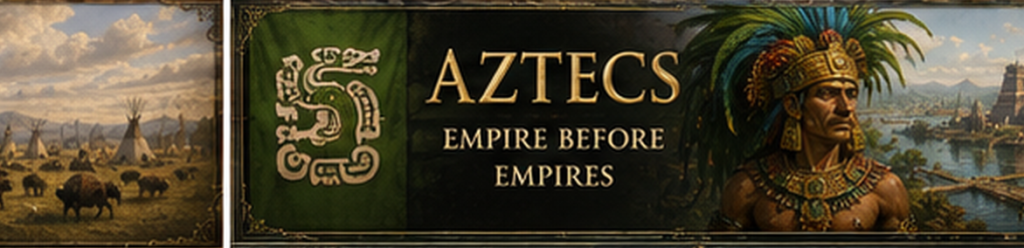
The Aztecs are particularly interesting because they remind us that the colonial game did not begin with Europeans.
Tenochtitlan was a major city in an already-developed political and economic world. The Spanish victory in 1521 depended not only on European weapons but on alliances with Indigenous enemies of the Aztec Empire, internal political divisions and devastating Old World disease. Turning that complicated struggle into “Spain arrives and defeats the Aztecs” removes most of what actually made the conquest possible.
Geographically, though, the consequence was enormous. Spain gained control of the core of a powerful existing empire and used central Mexico as the foundation for its northern expansion. One playable Age of Empires III civilization was therefore incorporated into the colonial system of another, and the resulting New Spain would eventually stretch deep into what is now the United States.
France: The Civilization That Followed the Water

France played perhaps the most geographically elegant strategy of any European power.
The St. Lawrence River became the entrance to the continent. From there, waterways opened toward the Great Lakes, and the Great Lakes connected French traders, explorers and soldiers to river systems extending deep into the interior. Farther south, the Mississippi provided a watery spine running toward Louisiana and the Gulf of Mexico.
Quebec was founded by Samuel de Champlain in 1608, and over the following century French trade routes, settlements, missions and forts formed an extraordinary continental network. On a map, New France eventually looked gigantic, connecting the St. Lawrence region with the Great Lakes and Mississippi Valley all the way toward the Gulf. Yet its demographic weakness was astonishing: around 1750 Canada contained roughly 55,000 inhabitants and Louisiana fewer than 9,000, while Britain’s North American colonies were approaching 1.5 million.
That may be the closest real-world equivalent to an Age of Empires player who has excellent map control but forgot to keep producing villagers.
France’s reach depended heavily on Indigenous trade networks and alliances. Europeans were entering political systems that already existed, not building civilization in a vacuum. French influence could therefore extend astonishing distances without anything resembling dense French settlement across those territories.
Britain: The Civilization That Kept Producing Settlers

Britain’s strategy developed almost in reverse.
The first permanent English settlement at Jamestown was founded in Virginia in 1607, and its early years were anything but an easy expansion. Disease, hunger, warfare and dependence on relationships with the surrounding Powhatan peoples nearly destroyed the colony. Jamestown nevertheless survived and helped establish the foundation for a much larger English colonial system.
Over time, colonies multiplied along the Atlantic seaboard. Virginia’s tobacco economy expanded, New England settlements grew, Pennsylvania developed around Philadelphia, and Britain’s colonial population increased at a rate France could not match. Geography initially constrained this growth between the Atlantic and the Appalachian Mountains, producing a relatively narrow but increasingly dense zone of European settlement.
This creates one of the great visual contradictions of eighteenth-century North America. France looked larger on the map; Britain was far larger in population. In Age of Empires terms, France had aggressively taken the map while Britain quietly built an economic boom behind its walls.
Eventually, the boom mattered more.
The Dutch: The Traders Who Built New York Before It Was New York

The Dutch entered the game through one of North America’s most valuable geographical corridors: the Hudson River.
New Netherland grew around commerce and the fur trade. New Amsterdam developed at the southern end of Manhattan while Fort Orange, near modern Albany, connected Dutch merchants with the interior and Indigenous trading partners. The Hudson gave the Dutch a remarkable route from a superb Atlantic harbour toward the heart of the northeast.
Then, in 1664, English forces arrived.
Peter Stuyvesant surrendered New Amsterdam without a major battle, and the English took possession of New Netherland. New Amsterdam became New York, while Dutch cultural and economic influence continued long after the flag changed.
From an AoE III perspective, this is brutal. The Dutch spent decades developing a profitable economy only for another player to capture their main base.
Sweden: The Colony Most People Don’t Know Existed

Sweden’s story sounds almost like obscure downloadable content added to history after release.
In 1638, Swedish and Finnish settlers arrived on the Christina River in what is now Wilmington, Delaware. They built Fort Christina and established New Sweden, a small colony centred on farming and the fur trade. Its territory touched portions of the modern Delaware Valley across what became Delaware, Pennsylvania and New Jersey.
The geographical problem was that the Dutch also wanted the Delaware River. In 1655, Dutch forces captured Fort Christina and ended New Sweden as an independent colony. Nine years later, the English seized the wider Dutch empire.
So parts of the Delaware Valley effectively moved through three European players within a remarkably short period:
- Swedish control
- Dutch control
- English control
Yet Swedish and Finnish settlers remained, and their cultural legacy survived the disappearance of the colony itself. Of all the playable AoE III civilizations, Sweden may provide the best example of how bizarre the real colonial map actually became.
Portugal: Was There Really a Portuguese Colony in Canada?

Portugal is where the historical map becomes genuinely mysterious.
Portuguese mariners were active around Newfoundland and Labrador very early in the sixteenth century, especially in connection with Atlantic fisheries. Around 1520, João Álvares Fagundes explored portions of the region and later received royal rights over lands associated with his discoveries. Portuguese maps and place names show that Portugal’s interest in northeastern North America was real.
Then comes the intriguing part. Later accounts suggest that a group associated with Fagundes may have attempted to establish a colony somewhere around Cape Breton, possibly during the early 1520s. The problem is that surviving evidence does not allow historians to establish the location or even the colony’s existence with certainty; Newfoundland and Labrador Heritage specifically treats it as a theory rather than settled fact.
That makes Portugal the perfect civilization for the slightly skeptical reader. There was real Portuguese exploration, fishing and territorial interest in North America, but there was never a durable Portuguese equivalent of New Spain, New France or British America.
Portugal explored this map.
It simply chose to build its empire elsewhere.
The Germans: Settlers Without a German Empire

The “Germans” create another historical complication because Germany did not exist as a unified nation-state during most of the period represented by Age of Empires III.
German-speaking Europe consisted of numerous states and territories. There was therefore no colonial territory called “New Germany” competing with New France or New Spain. Yet German-speaking migrants became extremely important settlers inside other powers’ colonies.
A famous example is Germantown, founded near Philadelphia in 1683 by German-speaking settlers. Library of Congress material records thirteen families — 33 people — arriving that year and establishing the community within William Penn’s Pennsylvania.
So the Germans were absolutely present on the North American map.
They just did not own their own colour.
The Ottomans: A Major Power on the Wrong Battlefield

The Ottoman Empire exposes perhaps the simplest misconception about Age of Empires III: not every civilization in the game is there because it colonized North America.
The Ottomans were one of the great powers of the early modern era, controlling enormous territories across southeastern Europe, Anatolia, North Africa and the Middle East. They belonged in a game about global empires between the sixteenth and nineteenth centuries.
But there was no Ottoman North American territorial empire comparable to those of Spain, France, Britain, the Netherlands or Russia.
In other words, if this were the real multiplayer map, the Ottoman player spawned somewhere else.
Russia: The Civilization That Came From the Opposite Direction

Russia is different from almost everybody else because it did not arrive across the Atlantic.
Russian expansion moved eastward across Siberia until traders and explorers reached the North Pacific. Alaska lies surprisingly close to northeastern Asia, and during the eighteenth century the lucrative sea-otter fur trade encouraged Russian merchants to cross into North America.
The first permanent Russian settlement in Alaska was established at Three Saints Bay on Kodiak Island in 1784. Russian commercial activity expanded, eventually producing the Russian-American Company and a colonial capital at New Archangel, modern Sitka.
Russia’s claims were again much larger than its actual settlement network. Russian power depended heavily on coastal posts and the fur trade, while Indigenous communities — including the Tlingit and Unangax̂/Aleut peoples — resisted, negotiated with and were frequently exploited by Russian colonizers.
Then, in 1867, Russia simply sold Alaska to the United States.
The Russian player left the match and sold its final base.
The Haudenosaunee and Lakota: The Map Was Never Empty

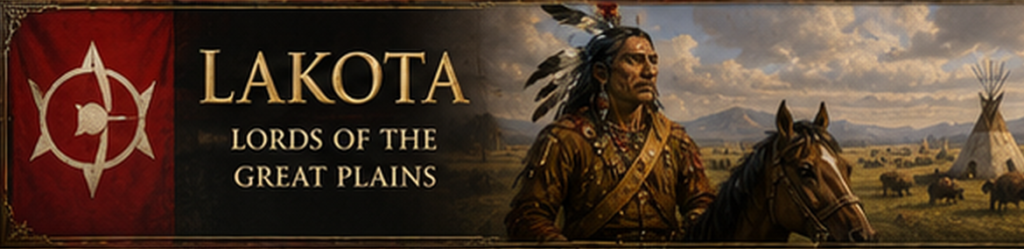
This is where the Age of Empires metaphor can become dangerously misleading unless we correct it.
European colonial maps often show giant coloured territories as if Spain, Britain or France possessed complete political control. They did not. Indigenous nations continued controlling huge areas, and European power often depended on negotiating with them.
The Haudenosaunee occupied a particularly strategic region across much of present-day New York. Their position between the Hudson system, Great Lakes and St. Lawrence world made them enormously important in diplomacy, warfare and trade involving the Dutch, British and French. The Confederacy was not an NPC faction caught between European players; it was a geopolitical power pursuing its own interests.
The Lakota likewise became a major force across the northern Great Plains. European and later American maps might claim those lands for distant governments, but a coloured boundary on paper did not magically produce effective authority on the ground.
That is one of the biggest corrections we need to make when turning Age of Empires III into real history:
the fog of war contained civilizations already there.
Who Had the Best Real-World AoE III Strategy?
Placed side by side, the differences become striking.
| Civilization | North American Role | Geographic Core | Strategy in AoE Terms |
|---|---|---|---|
| Spanish | Major empire | Mexico, Florida, Southwest, California | Early expansion, forts, missions |
| French | Huge but lightly populated empire | St. Lawrence, Great Lakes, Mississippi | Trade-route and map-control strategy |
| British | Dense settler colonies | Atlantic seaboard | Economic boom and settler production |
| Dutch | Commercial colony | Hudson and Delaware | Trade-focused economy |
| Swedish | Small colony | Delaware Valley | Limited expansion and farming |
| Portuguese | Exploration and possible settlement | Atlantic Canada | Explore, fish, then switch maps |
| Germans | Migration without state empire | Especially Pennsylvania | Settlers inside another player’s territory |
| Ottomans | No North American territorial empire | — | Playing another map |
| Russians | Pacific colonial network | Alaska | Fur economy and remote outposts |
| Haudenosaunee | Indigenous geopolitical power | New York / Great Lakes approaches | Diplomacy, trade and strategic positioning |
| Lakota | Plains power | Northern Great Plains | Mobility and territorial influence |
| Aztecs | Existing empire conquered by Spain | Central Mexico | Powerful starting civilization |
| United States | Breakaway British colonies | Atlantic colonies, then interior | Revolution followed by expansion |
| Mexico | Successor to New Spain | Mexico and Southwest | Independence followed by territorial struggle |
What immediately becomes obvious is that there was no single colonial strategy. Geography dictated everything.
The Seven Years’ War: When the Match Finally Exploded
By the middle of the eighteenth century, Britain’s expanding settlements and France’s continental network were running directly into one another.
The Ohio Valley became particularly dangerous. French claims connected Canada with Louisiana, while British colonists and land speculators increasingly looked west across the Appalachians. Forts, rivers and portage routes suddenly became pieces on an imperial chessboard.
The resulting Seven Years’ War became a global conflict, but North America was one of its critical theatres. Britain emerged victorious, and the Treaty of Paris in 1763 transferred Canada and French territory east of the Mississippi to Britain while Spain surrendered Florida. France’s enormous mainland North American empire was essentially dismantled.
On paper, Britain had won.
Then came the plot twist.
Only thirteen years later, thirteen British colonies declared independence.
The United States and Mexico: New Civilizations Spawn From Old Empires
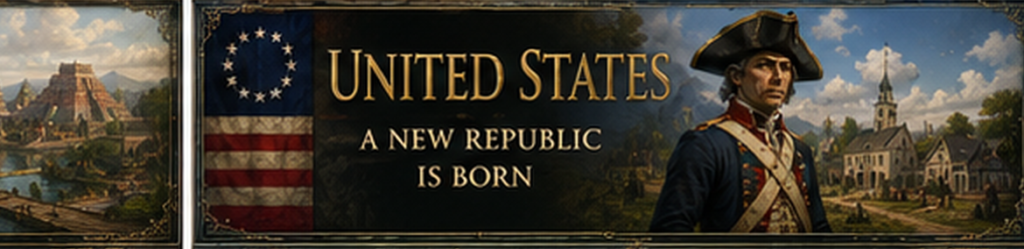
The United States civilization in Age of Empires III: Definitive Edition makes historical sense precisely because it emerged from the British colonial system rather than arriving as another overseas empire. The official game describes the United States as its own playable civilization with state-based advancement mechanics, fitting the country’s unusual origins remarkably well.
Mexico followed a comparable transformation from another empire. After centuries of Spanish rule, Mexico became independent in 1821 and inherited an enormous northern territory from New Spain. California, New Mexico and Texas were all Mexican before becoming parts of the modern United States.
Official AoE III material similarly presents Mexico as a playable civilization born out of revolt against Spanish colonial rule.
That creates a wonderful historical progression inside the game’s roster itself: Aztec territory becomes part of New Spain; New Spain eventually produces Mexico. British America eventually produces the United States.
The civilizations change, but the geography underneath them remains.
What Age of Empires III Gets Wrong — and Surprisingly Right
Nobody should use Age of Empires III as a substitute for a history textbook. Colonization was vastly more complicated and brutal than constructing Town Centers and collecting treasure. Disease, enslavement, forced labour, religious conversion, displacement, warfare, ecological change and Indigenous resistance shaped the continent in ways a strategy game cannot adequately reproduce.
The game also encourages a very European idea of territory: explore land, build something and it becomes yours. Historically, that is precisely the assumption we should be skeptical about. A French map colouring the interior blue or a Spanish map extending a border across the Southwest tells us what an empire claimed, not necessarily what it effectively governed.
Yet the game gets something surprisingly important right.
Geography is power.
Rivers really did function like transportation highways. Harbours determined where cities grew. Forts guarded chokepoints. Trading relationships could be more valuable than sprawling settlement. Population growth could eventually overpower enormous but thinly defended territorial claims.
That may be why the game feels so convincing even when its history is simplified.
Its map logic works.
The Old Age of Empires Map Is Still There
The best part is that these civilizations left physical traces that can still be visited.
Walk through St. Augustine and you are standing inside Spain’s Florida frontier. Visit Quebec City and the geographical logic of New France becomes immediately obvious as the St. Lawrence dominates the landscape. Historic Jamestowne preserves the precarious beginnings of English Virginia, while Lower Manhattan occupies the ground where New Amsterdam once stood.
Wilmington still preserves the site of Swedish Fort Christina. Santa Fe remains one of the great surviving cities of Spain’s northern frontier. Sitka retains layers of Tlingit, Russian and American history from the Pacific side of the continent.
These places are separated by thousands of kilometres, yet historically they belonged to the same enormous contest.
They were bases on the same map.
Final Verdict: Who Won the Real Age of Empires?
There is no single answer because you have to choose the year first.
Stop around 1600 and Spain looks terrifyingly powerful. Move forward to 1700 and Britain and France are rapidly becoming rivals while the Dutch and Swedish experiments have already been absorbed. Jump to 1763 and Britain appears to have won eastern North America outright.
Then 1776 happens.
By 1821 Mexico has replaced Spain across much of New Spain. By 1867 Russia has sold Alaska. Meanwhile, Indigenous nations continue existing through every supposed European “victory,” despite imperial maps repeatedly treating their territories as possessions to be transferred between distant governments.
That is what makes the real history behind Age of Empires III better than the simplified version.
The British really did capture the Dutch colony that became New York. The Dutch really did conquer New Sweden. France really did build a gigantic interior network around rivers, lakes, forts and trade. Spain really did expand from Mexico into Florida, New Mexico, Texas and California. Russia really did build a colonial empire in Alaska from the opposite side of the continent.
And Portugal really might have attempted a tiny colony in Atlantic Canada that historians still cannot locate with certainty.
So the next time your Age of Empires III explorer rides into the fog of war, imagine the real version.
Beyond the trees could be a French trader following a river toward the Great Lakes. A British ship might be entering Chesapeake Bay. Dutch merchants could be working the Hudson. Spanish soldiers might be riding north from Mexico. Swedish settlers might be building beside the Delaware, while Russian hunters cross the North Pacific thousands of kilometres away.
And somewhere between all those European flags are powerful Indigenous nations watching the newcomers enter a continent that was never empty to begin with.
The real Age of Empires was not a game about discovering North America. It was a struggle over a map that millions of people already called home.
Further Reading
The U.S. National Park Service has an excellent overview of Spain’s mission system and northern expansion. Spanish Colonial Missions — National Park Service
For the French side of the story, the Canadian Museum of History provides a particularly useful overview of New France’s extraordinary territorial reach and relatively tiny population. French Colonial Expansion — Canadian Museum of History
This gave me new perspective. It seems the creators of AOE3 may have had a hard time finding variance with countries to play since the real dominance of the new world was Britain and Spain with a little France sprinkled in the middle and a big pot of different aboriginal tribes. This all just lead to the independence of Mexico and US then finally Canada.