
Legendary Animals of Canada’s Forests and Coasts
Canada has more than enough wilderness to conceal an animal—or at least convince someone that it could. Beyond the highways and settled corridors lie temperate rainforests, abandoned mining districts, northern mountain valleys, and coastlines broken by fog, islands, and narrow channels. In such places, an unidentified shape does not always remain unidentified. Sometimes it acquires a name, a history, and eventually a place in regional folklore.
The country’s lake monsters receive most of the attention, but they represent only one branch of Canada’s creature lore. Hair-covered figures have reportedly crossed forest roads in British Columbia and Ontario. Enormous pale canids are said to haunt northern valleys, while serpentine animals have been described along both the Pacific and Atlantic coasts. In eastern forests, the legendary animal may be something scientists know exists—the mystery is whether it still lives there.
These stories do not all belong in the same category. Some originated as newspaper sensations, some developed around genuine wildlife mysteries, and others have been loosely connected to Indigenous traditions that are older and more culturally significant than modern cryptozoology. Treating every unusual being as a “monster” erases those differences.
The most interesting question, therefore, is not simply whether these legendary animals are real. It is how Canada’s geography, wildlife, history, and storytelling traditions combined to create creatures that still seem at home in the landscape.
At a Glance: Canada’s Legendary Animals
| Legendary animal | Region most closely associated with it | Typical description | Nature of the story |
|---|---|---|---|
| Sasquatch | Southwestern British Columbia | Large, upright, hair-covered figure | Indigenous cultural traditions combined with modern cryptid lore |
| Old Yellow Top | Cobalt area, Ontario | Hairy humanoid with a yellow or blond head | Northern Ontario mining-era legend |
| Waheela | Northwest Territories, particularly the Nahanni region | Enormous white wolf-like predator | Modern cryptozoological story with disputed folklore connections |
| Phantom cougar | Eastern Canada | Large tawny or black cat | Real species surrounded by uncertainty about local populations |
| Cadborosaurus | Coastal British Columbia | Long, humped sea animal with a horse-like head | Newspaper-era sea-serpent legend |
| Atlantic sea serpents | Nova Scotia and Newfoundland waters | Long, undulating or many-humped marine creature | Maritime folklore, eyewitness reports, and misidentified wildlife |
| Giant squid | Newfoundland and the North Atlantic | Enormous deep-sea cephalopod | Former sea monster proven to be a real animal |
Why Canada Produces Such Convincing Creature Legends
Canada’s size is only part of the explanation. Large portions of the country are difficult to reach, but remoteness alone does not allow an unknown population of large animals to exist indefinitely. Animals leave tracks, hair, scat, carcasses, feeding sites, DNA, and eventually images from trail cameras. A breeding population leaves far more evidence than a lone animal passing through an area.
Nevertheless, Canadian terrain can make ordinary wildlife look extraordinary. Fog reduces contrast along the coast, while waves conceal most of a swimming animal’s body. A bear briefly standing upright may appear surprisingly human. A moose seen through thick bush can seem much larger or stranger than it is, and several marine mammals surfacing in sequence can resemble the exposed humps of one immense serpent.
Distance is especially difficult to judge when no familiar object is nearby for scale. A witness looking across open water may not know whether an animal is 50 metres away or several hundred metres away. That uncertainty affects every estimate that follows, including the creature’s length, speed, and the size of its head.
Canada’s history adds another layer. Prospectors, loggers, fishers, railway crews, trappers, and coastal sailors worked in places where isolation was normal and encounters with dangerous wildlife were entirely plausible. Their stories spread through camps, local newspapers, and community gatherings before entering books and, eventually, online cryptid catalogues. Each retelling could preserve the central mystery while quietly changing its details.
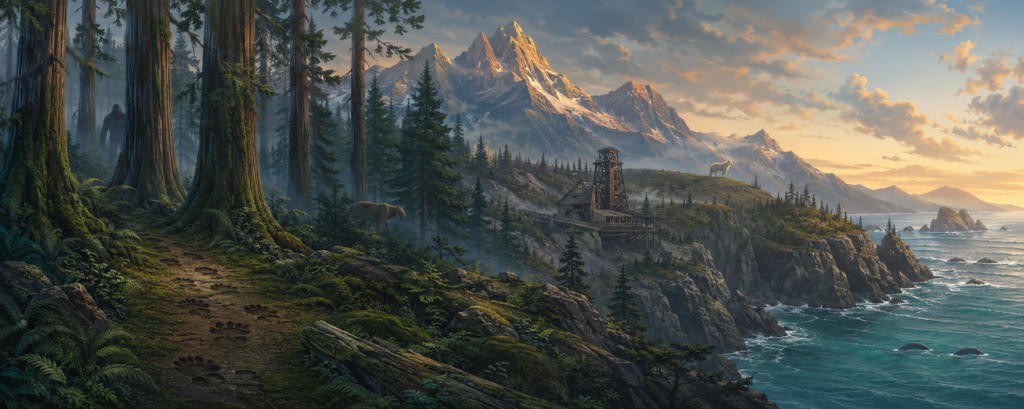
Sasquatch: British Columbia’s Hairy Mountain Figure
No legendary Canadian animal is more famous than Sasquatch. Most modern descriptions portray a tall, muscular, hair-covered figure that walks on two legs and disappears into the forests of the Pacific Northwest. In Canada, reported activity has been particularly associated with southwestern British Columbia, including the Fraser Valley, Harrison Lake region, and surrounding mountain country.
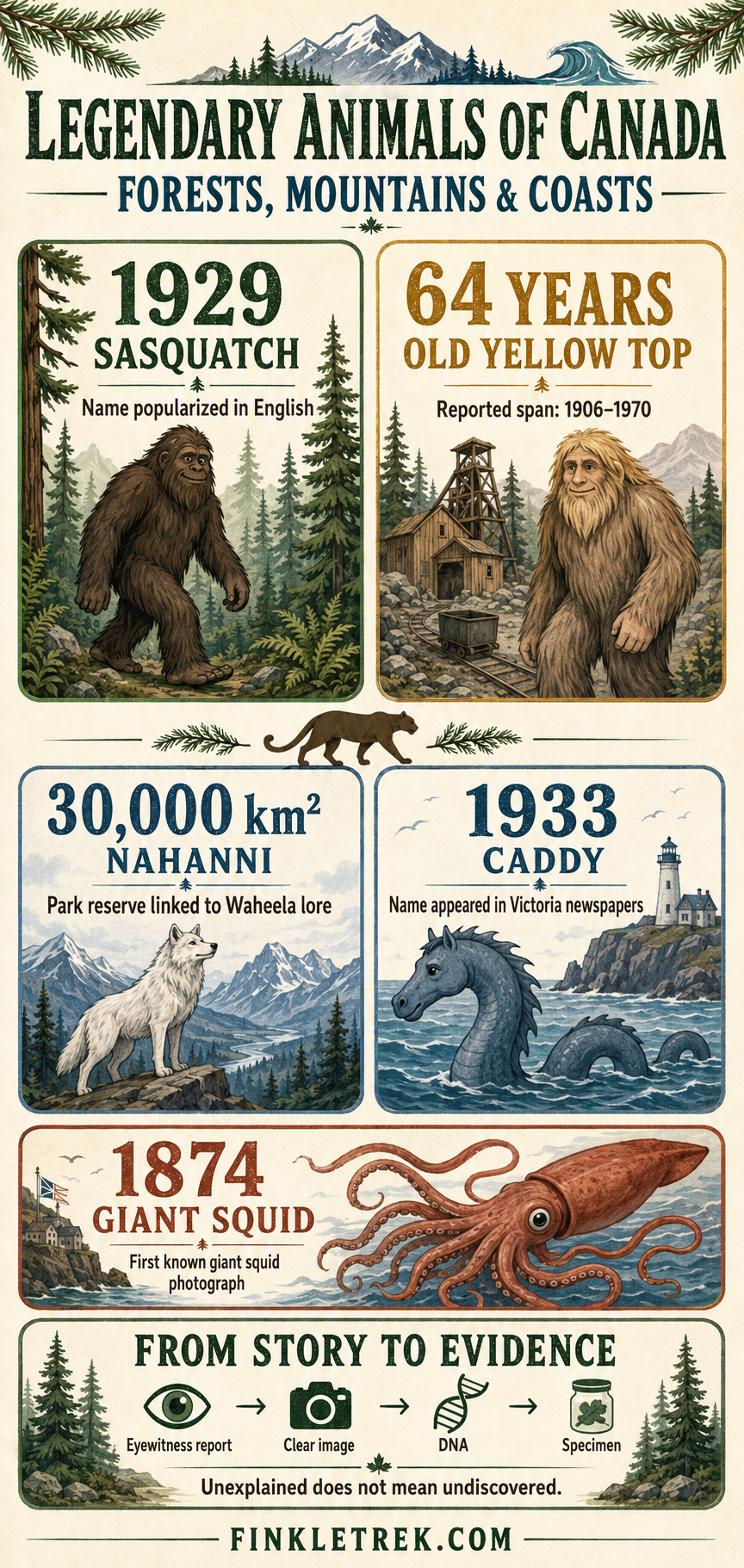
The English word “Sasquatch” is generally traced to an anglicization of Sasq’ets, a Halq’eméylem word commonly translated as “wild man” or “hairy man.” The term became widely known after teacher and Indian agent J.W. Burns published accounts of British Columbia’s “hairy giants” in 1929. Burns did not create the underlying traditions, but his writing helped package several accounts for a non-Indigenous audience and establish “Sasquatch” as a broadly applied name.
That history requires care. Indigenous communities across British Columbia have their own languages, beings, teachings, and interpretations. They should not all be collapsed into a single Western idea of an undiscovered ape. In some traditions, a forest being may be understood as closer to a person, ancestor, spirit, protector, or warning than to an animal awaiting scientific classification.
Modern Sasquatch reports usually focus on physical evidence: oversized footprints, distant vocalizations, broken branches, hair samples, indistinct photographs, and brief roadside sightings. None has produced a scientifically verified specimen or an accepted body of biological evidence. Alleged hair samples have generally belonged to known animals, while prints and photographs are vulnerable to hoaxes and mistaken identification.
Black bears remain one of the most plausible sources of certain sightings. A bear can stand and take several steps on its hind legs, particularly when investigating a scent or trying to see over vegetation. Poor light, fear, and an obstructed view can transform that brief movement into something more humanlike in the witness’s memory.
Yet Sasquatch endures because it fits coastal British Columbia almost perfectly. Dense vegetation limits visibility, steep terrain creates places people seldom enter, and the region contains animals large enough to make unsettling sounds and tracks. The legend transforms the forest from empty wilderness into inhabited territory—somewhere a watcher might always be standing beyond the tree line.
Old Yellow Top: The Wild Man of Northern Ontario
Far from British Columbia, the mining country around Cobalt, Ontario, developed its own hair-covered figure. Old Yellow Top, sometimes called the Pre-Cambrian Shield Man, was reportedly distinguished by a yellow or blond patch of hair around its head. The rest of the creature was generally described as dark, hairy, upright, and broadly similar to a Sasquatch.
Frequently repeated versions of the legend begin with miners near Cobalt in 1906. Other alleged encounters are dated to 1923, the mid-1940s, and 1970. The last major account describes workers travelling by bus when a dark figure supposedly crossed or approached the road, frightening several passengers.
These dates create the appearance of a 64-year case history, but the surviving record is much thinner than that description suggests. Many modern summaries repeat one another, and not every detail can be traced easily to a contemporary report. The Old Yellow Top chronology is best treated as a folklore timeline rather than a collection of independently verified zoological observations.
The setting is nevertheless important. Early Cobalt was a silver-mining boomtown surrounded by the rocky, forested Canadian Shield. Workers travelled between mines, camps, railways, and isolated settlements at hours when bears and other wildlife were active. Industrial noise, blasting, poor lighting, and exhausted workers created ideal conditions for fleeting encounters.
Old Yellow Top may have begun with a bear, a person in unusual clothing, a distorted memory, or an invented camp story. Its significance lies in how thoroughly it belongs to one landscape. Unlike the continent-wide Bigfoot of popular culture, Old Yellow Top is rooted in northern Ontario’s mining history—a local wild man hiding at the boundary between the bush and the industrial frontier.
The Waheela: A White Predator in the Northern Wilderness
The Waheela is usually described as an immense white canid with a broad head, unusually large feet, powerful shoulders, and proportions unlike those of an ordinary wolf. Modern accounts place it in the Northwest Territories, often in or around the South Nahanni watershed. It is generally portrayed as solitary, aggressive, and adapted to severe northern conditions.
The location makes the story immediately compelling. Nahanni National Park Reserve protects roughly 30,000 square kilometres of mountains, plateaus, canyons, caves, alpine country, and wild river systems. It lies within the traditional territory of the Dehcho First Nations and remains a living cultural landscape—not an unoccupied backdrop for monster stories.
The modern Waheela profile appears to owe much of its popularity to cryptozoologist Ivan T. Sanderson, who wrote about a giant northern canid during the 1970s. Sanderson speculated that such reports might represent a surviving prehistoric predator. Later writers proposed dire wolves or amphicyonids, the extinct carnivores popularly known as “bear-dogs.”
Those explanations create exciting illustrations, but they do not fit the available evidence. Amphicyonids disappeared millions of years ago, while dire wolves belonged to a different and much more recent lineage. No fossil trail demonstrates that either survived into modern northern Canada, and no bones, tissue, DNA, or verified photographs establish the Waheela as an unknown species.
Online retellings also connect the Waheela to Amarok, a powerful wolf-like being in Inuit storytelling, or present it as a universal Indigenous legend. That connection should not be repeated uncritically. Inuit traditions, Dene traditions, and a twentieth-century cryptozoological animal are not interchangeable merely because they involve northern wolves.
Real northern wolves can be formidable animals, and pale coats are normal in some populations. A large wolf seen alone, partly obscured by snow or vegetation, could look very different from the slimmer grey wolves familiar from wildlife photographs. A grizzly bear viewed at the wrong angle could also produce a broad-headed, heavy-shouldered silhouette.
The Waheela persists because it gives animal form to the scale of the northern wilderness. It is less a creature with a strong evidence file than a modern symbol of places where human beings remain visitors rather than masters.
Phantom Cougars: When the Legendary Animal Is Real
Stories of cougars in eastern Canada occupy an unusual position between folklore and wildlife science. The cougar is unquestionably real and remains established in western Canada. The unresolved question is whether wild cougars occasionally reach eastern provinces—and whether any remnant or breeding population survives there.
For decades, residents of Ontario, Quebec, New Brunswick, and Nova Scotia have reported tawny cats with long tails. Some witnesses describe black cougars, although melanism—a genetic condition producing very dark pigmentation—has not been scientifically confirmed in North American cougars. Black-cat reports are therefore more likely to involve poor lighting, mistaken scale, another species, or an escaped exotic animal.
Most sightings leave no physical evidence. Tracks may belong to dogs, while bobcats can appear much larger when distance is misjudged. Photographs often lack enough detail to determine the animal’s size, tail length, or species. Escaped or deliberately released captive cougars further complicate the question.
In the early 2000s, hair collected at scent stations in Fundy National Park was identified through DNA analysis as belonging to cougars. That was meaningful evidence that at least one cougar had been present, but it did not establish the animal’s origin. It might have been a long-distance migrant from the west, a released captive, or something locally surviving.
This is why the phantom cougar is one of Canada’s most valuable creature stories. It demonstrates that an eyewitness can be correct about the animal while still being wrong about the larger explanation. Confirming one cougar does not automatically prove an undiscovered eastern subspecies or a hidden breeding population.
Cougars also show how quickly a “cryptid” can become a legitimate wildlife question. Unlike an alleged ape-man or prehistoric bear-dog, a wandering cougar requires no unknown anatomy or improbable survival through geological time. It requires only an elusive animal travelling farther than expected.
Cadborosaurus: The Sea Serpent of the Pacific Coast
Cadborosaurus, affectionately shortened to “Caddy,” is associated with Cadboro Bay near Victoria and the coastal waters surrounding Vancouver Island. Witness descriptions vary, but the classic Caddy has a long neck, a horse-like or camel-like head, a slender body, several exposed humps, flippers, and a broad tail.
Reports of serpentine marine animals existed along the Pacific coast before Caddy received its modern identity. The name “Cadborosaurus” emerged through Victoria newspaper coverage in 1933, when editor Archie Wills helped popularize it. That timing is notable: the Loch Ness Monster was also becoming an international newspaper sensation during the same period.
The most famous physical evidence appeared in 1937, when a strange carcass was reportedly removed from the stomach of a sperm whale processed at a whaling station on Haida Gwaii. Photographs show an elongated, badly damaged object, but no preserved specimen remains available for decisive examination. Suggested identities have included a fetal whale, decomposed shark, or sturgeon.
Basking sharks have repeatedly created sea-monster carcasses. As they decompose, the jaws and gill structures can fall away, leaving a small-looking head, long spine, and body shape resembling a prehistoric marine reptile. This transformation is sometimes called a pseudoplesiosaur carcass because the remains look superficially like the popular image of a plesiosaur.
Living animals can create similar illusions. Sea lions swimming in a line may appear to be the humps of one creature. Whales, oarfish, floating kelp, sturgeon, and groups of birds or seals can all produce part of the traditional sea-serpent profile.
Indigenous sea beings depicted or described by Pacific Northwest nations should not automatically be labelled early Cadborosaurus sightings. Those traditions have their own names, meanings, and cultural contexts. Caddy is best understood as a twentieth-century cryptozoological character that developed within a much older and more complicated coastal world.
Atlantic Sea Serpents and the Monster That Became Real
Canada’s Pacific coast does not have a monopoly on sea-serpent stories. Nova Scotia has a long record of mysterious animals reportedly seen in harbours, bays, and open coastal water. Descriptions include enormous snakes, ridged backs, rows of humps, strange heads, and animals moving with an undulating motion.
These reports changed with the culture around them. Early accounts were influenced by traditional images of dragons and biblical sea monsters. Nineteenth-century newspaper reports appeared during a period when naturalists were still cataloguing the world’s marine life, making an undiscovered serpent seem less implausible than it does today.
The Atlantic environment can produce extraordinary misidentifications. Grey seals raise surprisingly long necks above the water. Basking sharks grow to imposing sizes but feed on plankton rather than sailors. Whales may expose only disconnected portions of their bodies, and lines of porpoises can create the illusion of repeated humps.
Then there is the giant squid, an animal that warns against dismissing every ocean story too quickly. For centuries, enormous tentacled creatures belonged largely to sailors’ tales. Science eventually confirmed that giant squid were real deep-sea cephalopods, although not the ship-destroying monsters imagined in folklore.
Newfoundland played an important role in that transition. In late 1873, clergyman and amateur naturalist Moses Harvey acquired a complete giant squid caught by a fisherman. The animal was photographed draped over a bathtub in 1874, producing the first known photograph of a giant squid and giving zoologists valuable material to examine.
The squid did not validate every tale of the kraken. It demonstrated something more interesting: folklore may preserve distorted encounters with genuine animals. The animal can be real while its reported size, aggression, and supernatural abilities grow through retelling.
How to Evaluate a Legendary-Animal Report
A responsible investigation does not begin by deciding that every witness is lying—or that every unexplained sighting represents a new species. It begins by separating what the witness observed from what the witness concluded.
Useful questions include:
- How long was the animal visible?
- What were the lighting, weather, and water conditions?
- Was there a reliable object nearby for scale?
- Was the witness familiar with local bears, seals, wolves, or cougars?
- Did multiple witnesses describe the animal separately?
- Was physical evidence collected with a documented chain of custody?
- Does the proposed animal fit the region’s climate, food supply, and breeding requirements?
- Could a known animal reproduce the reported movement or silhouette?
A report can remain genuinely unexplained without becoming evidence of a new species. “Unidentified” describes the limits of the available information. It does not tell us what the animal was.
Respecting the Stories and the Places Behind Them
Creature tourism can encourage people to explore Canadian history and geography, but it also creates opportunities for careless storytelling. Indigenous beings should not be stripped from their original cultures and repackaged as generic cryptids. Community sources and Indigenous interpretations deserve priority whenever they are publicly available.
Visitors should also remember that these legendary landscapes contain real hazards. Bears, cougars, wolves, cold water, changing tides, unstable mine workings, and remote terrain are more immediate concerns than any alleged monster. Abandoned mines around historic districts should never be entered without authorization, and backcountry travel in places such as Nahanni requires serious planning and appropriate expertise.
Wildlife should not be pursued, baited, cornered, or harassed for photographs. If unusual tracks, hair, or remains are discovered, recording the location and notifying the appropriate wildlife authority is more valuable than removing material without documentation. A dramatic story is entertaining, but properly recorded evidence is what allows a mystery to be investigated.
Canada’s Wilderness Still Has Room for Legends
No verified specimen currently establishes Sasquatch, Old Yellow Top, the Waheela, Cadborosaurus, or an unknown Atlantic sea serpent as a living animal. That does not make their stories meaningless. Each creature reveals something about the environment and the people who travelled through it.
Sasquatch belongs to the dense forests and cultural history of southwestern British Columbia. Old Yellow Top emerged where mining camps pushed into the northern Ontario bush. The Waheela magnifies the remoteness of the northern mountains, while Caddy and the Atlantic sea serpents reflect the uncertainty of looking across cold, moving water.
The phantom cougar and giant squid make the boundary even more interesting. They remind us that known animals can vanish from a region, travel beyond expected ranges, or remain scientifically elusive for generations. Sometimes witnesses misidentify an ordinary creature. Sometimes the animal is real, but the legend surrounding it becomes larger than the evidence.
Canada’s legendary animals endure because the landscapes still feel capable of holding them. A dark forest, fog-covered channel, or northern valley does not offer certainty at first glance. It offers just enough distance for an animal to disappear—and just enough uncertainty for a story to begin.
- Sasquatch — The Canadian Encyclopedia — Explores the Canadian history, reported sightings, terminology, and cultural background associated with Sasquatch.
- Sea Serpents and Other Marine Creatures from Nova Scotia’s History — A Nova Scotia Museum publication examining historical marine-creature reports alongside folklore and natural history.