

Britain Before the Legend: A Land Shaped by Invasion
Britain’s identity was not born in stability. It was forged in resistance.
From the Roman invasion in 43 AD to the Anglo-Saxon migrations of the 5th century and the Norman Conquest of 1066, Britain repeatedly faced external domination. Each wave of conquest forced adaptation, rebellion, and redefinition.
The heroes Britain remembers — whether documented or legendary — often share a common thread: they stand at moments of cultural fracture.
To understand Arthur, Merlin, Camelot, and Lancelot, we must first understand that Britain’s myths are rooted in conflict, not fantasy.
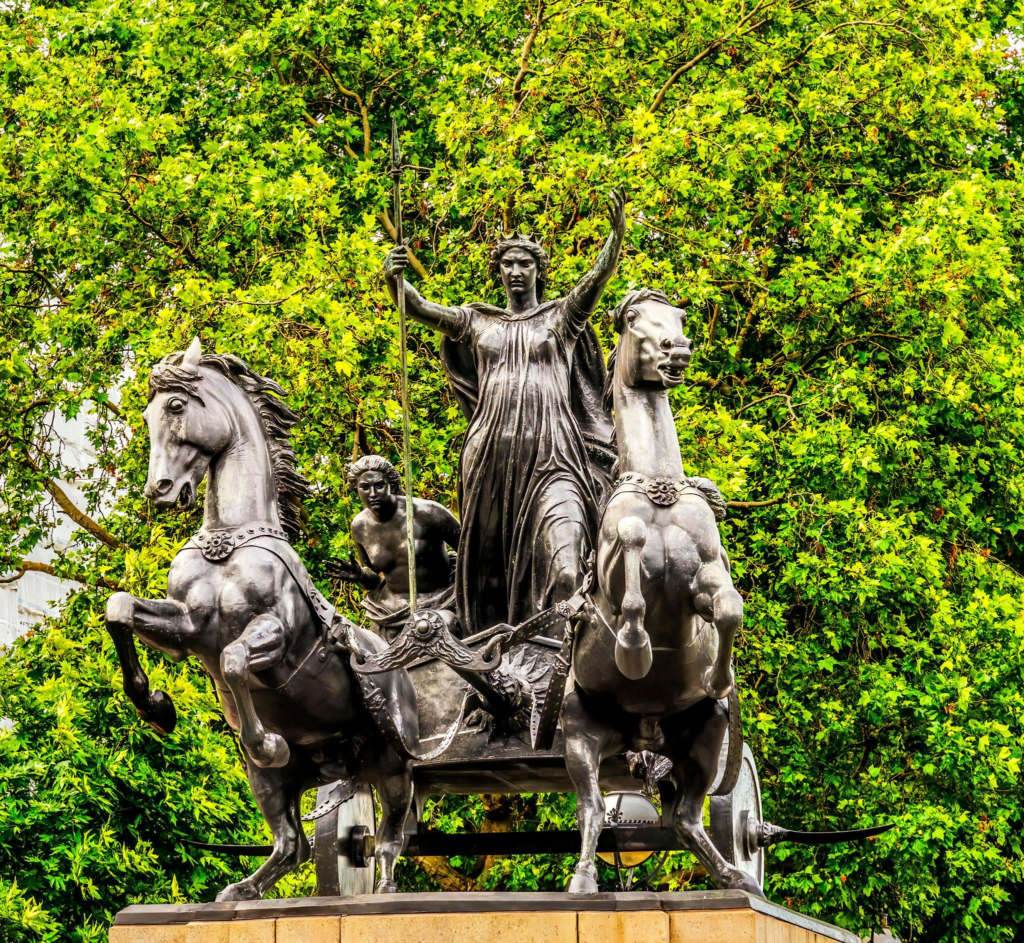
Boudica: The Historical Queen Who Burned Roman Cities
Long before Arthur’s supposed era, Britain produced a documented resistance leader:
Boudica.
In 60–61 AD, after Roman officials flogged her and assaulted her daughters, Boudica united multiple tribes in revolt. Ancient historian Tacitus describes her leading tens of thousands against Roman settlements. Camulodunum (Colchester), Londinium (London), and Verulamium were destroyed.
Though ultimately defeated by disciplined Roman legions, Boudica nearly expelled Roman authority from southern Britain.
She was not mystical. She was political and strategic.
Her importance lies in precedent. She established the template of the British resistance hero: wronged by empire, rallying tribes, nearly overturning domination.
Centuries later, Arthur’s legend would echo this same structure — but against Saxons rather than Romans.
After Rome: The Vacuum That Created Arthur
When Rome withdrew from Britain in 410 AD, administrative order collapsed. Roman roads remained, but centralized defense did not. Trade diminished. Coastal settlements faced Saxon pressure.
In this power vacuum, Romano-British elites attempted to preserve territory.
It is here that a figure remembered as Arthur may have operated — not as a crowned monarch ruling from a marble palace, but as a military coalition leader coordinating fragmented resistance.
The earliest references to Arthur are sparse. In the Historia Brittonum, he is described as a war leader fighting twelve battles. The Annales Cambriae mentions his death at Camlann.
That is all we can reliably say.
Yet sparse evidence is fertile ground for legend.
Geoffrey of Monmouth and the Rise of Camelot
In 1136,
Geoffrey of Monmouth
rewrote Britain’s past in Historia Regum Britanniae.
Arthur became a conqueror, ruling a unified Britain and defeating enemies beyond its shores. The kingdom of Camelot emerged as a symbol of political perfection.
Camelot was likely never a single identifiable capital. Sites such as Tintagel and Cadbury Castle show early medieval occupation, but no definitive proof.
Camelot’s real function was symbolic. It represented unity during fragmentation, order during chaos, moral kingship in an era of unstable succession.
Arthur’s court became less a place and more a political dream.
Merlin: The Voice of Legitimacy
Merlin enters the story as prophet and advisor. Earlier Welsh traditions suggest Merlin may have roots in a wild prophetic figure known as Myrddin.
In medieval retellings, Merlin legitimizes Arthur’s rise. The sword in the stone is not merely spectacle; it is divine endorsement.
In unstable societies, legitimacy is fragile. Merlin supplies it.
He bridges pagan mysticism and Christian destiny. Through him, Arthur becomes inevitable rather than accidental.
Lancelot and the Birth of Chivalry
Lancelot was introduced through later French romance literature. He embodies idealized chivalry — bravery, devotion, martial excellence.
But he also embodies tragic flaw.
His affair with Queen Guinevere fractures Camelot’s unity. Arthur’s kingdom collapses not because of foreign invasion, but because internal loyalty disintegrates.
This narrative sophistication mirrors historical reality. Political systems often fail internally before external conquest completes their fall.
Camelot becomes a warning as much as an aspiration.
The Battle of Camlann and the Sleeping King
Arthur’s final battle at Camlann ends in devastation. He is mortally wounded and taken to Avalon.
In some versions, he does not die. He waits.
The phrase “The Once and Future King” captures this mythology. Arthur becomes a dormant protector — ready to return in Britain’s darkest hour.
This motif transforms a historical possibility into a national myth.
William Wallace: The Documented Medieval Rebel
Fast forward to the 13th century.
William Wallace was not legend. He was documented.
In the 1290s, Scotland faced English domination under Edward I. Wallace emerged as a leader of rebellion, famously defeating English forces at the Battle of Stirling Bridge in 1297.
Unlike Arthur, Wallace’s life is recorded in contemporary sources. His execution in 1305 was brutal and intended as a warning.
Yet like Arthur, Wallace became more than a man. Over time, he became a symbol of national resistance.
The 1995 film
Braveheart
amplified that mythos, blending fact with dramatization.
Wallace represents the historical counterpart to Arthur’s legendary role — a documented resistance hero elevated into mythic stature.
The Pattern of Resistance in British Memory
Across centuries, Britain returns to certain archetypes:
- Boudica resisting Rome
- Arthur resisting Saxons
- Wallace resisting English domination
Each figure arises during perceived existential threat.
Each becomes larger than documented reality.
Each reinforces cultural identity.
The land itself — Cornwall’s cliffs, Wales’ hillforts, Scotland’s highlands — reinforces the narrative. Geography shapes resistance. Terrain influences tactics. Isolation breeds autonomy.
These myths are anchored in physical landscapes that can still be visited.
Victorian Revival and the Reinvention of Arthur
In the 19th century, during the height of the British Empire, Arthurian legend experienced revival. Poets such as Alfred Lord Tennyson reimagined Camelot as a moral allegory for imperial Britain.
Arthur became the embodiment of duty, order, and sacrifice — virtues the empire sought to project.
Even in modern reinterpretations like
King Arthur,
filmmakers attempt to rediscover the “real” Arthur behind the myth.
The persistence of reinterpretation proves the legend’s adaptability.
Why These Figures Endure
Boudica, Arthur, and Wallace differ in documentation and scale, yet they share thematic continuity.
They emerge at moments of political instability. They confront external power. They inspire unity. Their stories are reshaped by later generations.
Arthur may never be archaeologically confirmed. But the cultural need for him has been repeatedly confirmed.
Merlin supplies destiny.
Camelot supplies order.
Lancelot supplies moral complexity.
Boudica supplies historical precedent.
Wallace supplies documented resistance.
Together, they form a continuum of British identity built on the tension between domination and defiance.
Final Reflection: Myth as Memory
History records events. Myth preserves meaning.
Arthur’s ambiguity allows him to serve every era’s needs. Boudica reminds Britain that resistance predates medieval romance. Wallace shows that rebellion did not end in legend.
Walk the cliffs of Tintagel. Stand near Boudica’s statue in London. Visit Stirling Bridge in Scotland. These are not fairy tale locations. They are layered landscapes where memory and narrative intersect.
King Arthur may exist in shadow. But the need for him — and figures like him — is undeniable.
And that is why the legend survives.
Baldwin IV of Jerusalem – The Leper King Who Defied an Empire
This paragraph provides clear idea for the new visitors of blogging, that in fact how
to do blogging and site-building.