
Karl Bushby: The Man Who Has Been Walking Home for 28 Years
In November 1998, a 29-year-old former British paratrooper stepped onto a road in Punta Arenas, Chile, with about $500, a homemade equipment cart and an idea that bordered on insanity. Karl Bushby intended to travel from the southern end of South America all the way back to his home city of Hull, England, without using transportation to move himself forward. He thought it might take about 12 years.
Twenty-eight years later, he is still coming home.
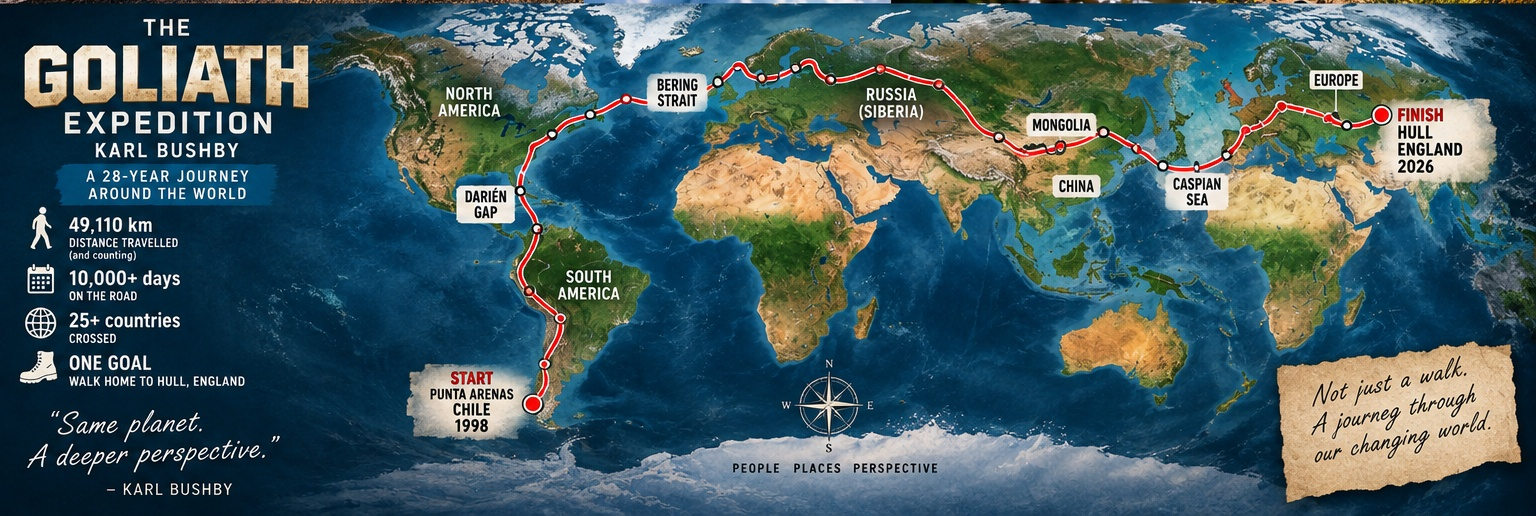
Since that first day, Bushby has crossed Patagonia, climbed through the Andes, entered one of the most dangerous jungles on Earth, walked across North America, crossed the frozen Bering Strait into Russia, battled Siberian winters, navigated authoritarian border controls, crossed Mongolia and China, waited through wars and pandemics, and eventually swam across the Caspian Sea when geopolitics made the land route effectively impossible. His official expedition records 49,110 kilometres travelled as of August 30, 2026, with roughly 900 kilometres remaining.
And now, astonishingly, he is almost home.
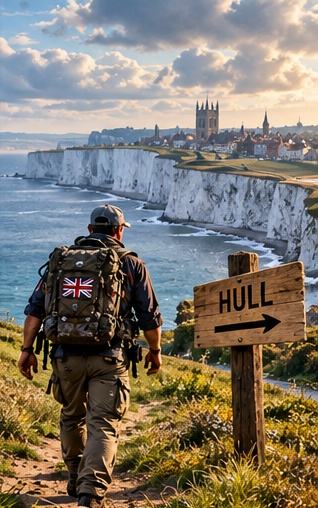
Bushby has reached Belgium and is heading toward France. The last major geographical obstacle is the English Channel, which he currently plans to cross by swimming on or around October 1, 2026, depending on tides and weather. If that succeeds, there will be one final walk north across England toward Hull — ending a journey that began when Bill Clinton was president, Google was barely a company and smartphones did not exist.
The Goliath Expedition is not simply a story about walking a very long distance. It is a story about what happens when one human being draws a line across the world and then spends almost half his life refusing to break it.
The Idea Was Almost Ridiculously Simple
Bushby calls his journey the Goliath Expedition. The idea grew during the 1990s after a birthday card from his father mentioned soldiers discussing whether someone could walk from London to New York by travelling east across Eurasia and somehow crossing the Bering Strait. Bushby looked at a map and took the thought much further, tracing a continuous route between Britain and the southern tip of South America.
Rather than beginning at home and walking away from it, he decided to start at the far end and walk back. Punta Arenas, on the Strait of Magellan in southern Chile, became the beginning. Hull became the destination.
The rules were deliberately unforgiving.
- He could not use transportation to advance along his route.
- If forced away from the expedition because of visas, money or politics, he had to return to the point where he stopped.
- He would not simply abandon the journey and return home before completing it.
- Where walking became physically impossible, progress still had to be made under his own power.
That last rule would eventually become incredibly important. Bushby did not know in 1998 that it would lead him onto drifting Arctic sea ice or force him to spend more than 130 hours swimming across the Caspian Sea. He simply knew that the line could not be broken.
Day One Almost Ended in Disaster
There is something strangely appropriate about how the expedition began.
On November 1, 1998, Bushby assembled the cart that would carry his supplies through South America. He reportedly managed to travel only around 20 metres before the wheel mechanism failed and damaged the axle assembly. His expedition, which was supposed to span continents, had effectively broken down within sight of where it started.
He repaired the equipment and continued north.
Patagonia immediately demonstrated why distance alone was not going to be the greatest challenge. Powerful winds battered both Bushby and his cart, sometimes stopping him entirely. Farther north came the Atacama Desert and the high elevations of the Andes, where hunger, heat, isolation and thin air became part of everyday travel. At times, according to his expedition account, he survived on discarded or scavenged food while still trying to cover roughly 30 kilometres per day.
Two years later he reached Colombia.
The journey was about to become considerably more dangerous.
Colombia and the Darién Gap
Anyone who has studied a road map stretching from Alaska to South America eventually notices something unusual between Panama and Colombia.
The road disappears.
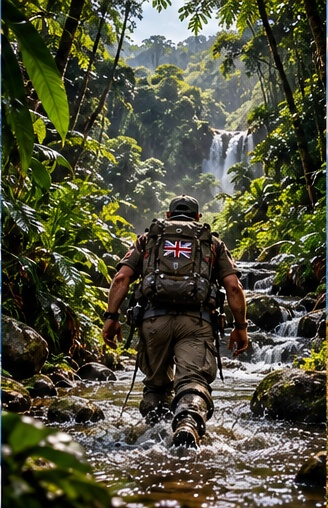
The Pan-American Highway, which otherwise extends across enormous portions of the Americas, is interrupted by the Darién Gap, a wilderness of rainforest, mountains, rivers and swamps roughly 100 to 160 kilometres wide depending on how it is measured. There is no continuous highway through it.
When Bushby approached the region in 2000 and 2001, geography was only part of the problem. Colombia was still experiencing intense conflict involving FARC guerrillas, paramilitary organizations, government forces and criminal groups. Kidnapping was a serious concern, particularly for a conspicuous foreign traveller walking alone.
Bushby spent weeks gathering information in Medellín and preparing for the crossing almost like a military escape-and-evasion operation. He reportedly developed alternate routes depending on what he encountered and spoke with soldiers, police, journalists and local residents familiar with the area.
Then he entered the jungle.
According to Bushby’s expedition account, he sometimes travelled cautiously around armed groups and used waterways where the swamp made conventional walking impossible. During one section along the Atrato River, he kept close to vegetation and attempted to resemble floating debris to avoid attracting attention from passing boats while also watching the water for crocodiles.
It sounds almost too cinematic to be true, but Bushby’s own contemporary accounts describe the fear clearly. Before entering one particularly dangerous area, a Colombian officer reportedly documented that Bushby had been warned about the risks. Bushby wrote a letter to his family in case he did not come out.
He did come out.
After roughly ten days through the most isolated portion of the jungle, he reached Panama — where another problem immediately appeared. Because he had entered the country through wilderness rather than a normal border post, authorities detained him, and he eventually spent 18 days in a Panamanian jail before being allowed to continue.
He had survived one of the most intimidating sections on his map.
The expedition was barely two years old.
Walking North Through the Americas
From Panama, the landscape gradually changed from jungle survival to a different kind of punishment: thousands upon thousands of kilometres of highway.
Bushby passed through Central America and Mexico before heading into the United States. In León, Nicaragua, he had another cart constructed — eventually nicknamed “The Beast” — to carry the supplies necessary for the increasingly long and isolated stretches ahead.
The expedition also began intersecting with history.
On September 11, 2001, Bushby walked into a restaurant in Tonalá, Mexico, and noticed a burning skyscraper on television. He was still watching when the second aircraft struck the World Trade Center. Speaking little Spanish and isolated from the instant stream of information most of the world was receiving, he initially struggled to understand exactly what he was witnessing.
That moment is one of the strangest ways to understand the scale of his expedition. Bushby started walking before 9/11. He was still walking through the global financial crisis, still walking when smartphones transformed everyday life, still walking when COVID-19 shut international borders, and still walking when Russia invaded Ukraine.
The world around the expedition kept changing.
The line remained.
From Desert Heat to the Canadian Rockies
Crossing the southwestern United States brought temperatures approaching 50°C. Bushby’s expedition journals describe water bottles becoming painfully hot and equipment adhesives softening in the desert heat.
Then the landscape slowly transformed.
He continued north through the United States and entered Canada, eventually following routes through the Canadian Rockies and toward the Alaska Highway. Temperatures that had once approached 50°C eventually fell toward -40°C.
In Alaska, conditions became truly polar. Bushby reached Fairbanks in 2004 and began preparing for a completely different form of travel. Roads were becoming less useful, and some routes could actually become easier during the coldest months because rivers and wetlands froze solid enough to cross.
During one Alaskan winter, Bushby’s expedition account says he returned roughly 40 pounds lighter after travelling through temperatures near -50°C.
Yet Alaska was merely the approach.
Beyond it was a strip of water that had always threatened to make the entire concept impossible.
The Bering Strait
The Bering Strait separates Alaska from Russia.
At its narrowest, North America and Asia are remarkably close together, but that does not make travelling between them easy. The water is frigid, currents are powerful and winter sea ice does not form a simple stationary bridge from one continent to the other.
In March 2006, Bushby and French-American adventurer Dimitri Kieffer began attempting to cross it.
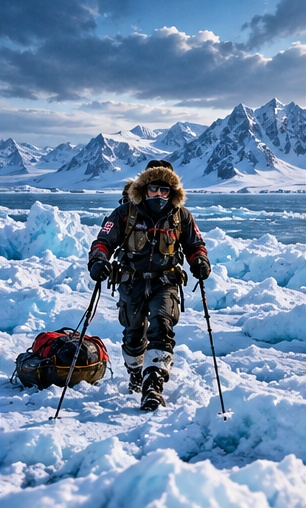
They travelled across broken and shifting sea ice while hauling equipment behind them. Pressure ridges rose where ice collided. Other sections opened into freezing water. More dangerously, the ice beneath their feet was constantly moving with the currents.
Bushby and Kieffer could walk in the correct direction all day, camp for the night and wake up having drifted kilometres away from where they wanted to be.
At one point during preparations for the crossing, the two men were swept roughly 30 kilometres offshore on unstable ice and required helicopter rescue. Bushby’s expedition was not considered over because they later resumed from the point where their human-powered route had stopped rather than using that rescue to move forward.
When the successful attempt finally came, the Bering Strait’s roughly 58-mile distance became something much longer. Bushby’s records say they travelled approximately 150 miles over 14 days because of the drifting ice and constant zigzagging required to find safe passages. Temperatures plunged, supplies dwindled and sections of open water repeatedly threatened to stop them.
Finally, the Russian coast came into view.
After nearly eight years of walking, Bushby had left the Americas behind and stepped onto Siberia.
Then Russian authorities arrested him.
The Walk That Almost Ended at the Russian Border
Bushby and Kieffer had entered Russia near Uelen, on the Chukchi Peninsula, rather than through a normal immigration checkpoint.
From Russia’s perspective, two foreigners carrying sophisticated expedition equipment had appeared out of the Bering Strait in a sensitive border region without completing the usual entry procedures. They were detained and accused of entering illegally.
A Russian court initially ordered their deportation.
For Kieffer, that was a serious inconvenience. For Bushby, it potentially destroyed the entire expedition. Deportation could have triggered a five-year ban from Russia, leaving thousands of kilometres of his continuous route inaccessible.
The story received international attention. British deputy prime minister John Prescott, whose parliamentary constituency included Bushby’s home city of Hull, became involved. Roman Abramovich — then governor of the Chukotka region and already famous internationally as the billionaire owner of Chelsea Football Club — was reportedly involved behind the scenes as well.
On May 5, 2006, a Russian appeals court overturned the deportation order. Bushby was allowed to continue.
The ice had nearly killed the expedition physically.
Russian bureaucracy nearly killed it legally.
And the Russian section had barely begun.
Siberia Was Not One Walk — It Was Years of Returning
Looking at a map, Russia seems like an enormous but straightforward problem: simply keep walking west.
Reality was much stranger.
Some areas of Siberia could only be crossed effectively during deep winter, when rivers, marshes and tundra froze hard enough to support travel. Arrive during the wrong season and those same routes became networks of open water, mud and swamp.
Then there were visas.
Bushby could not simply remain indefinitely in Russia while waiting for ideal conditions. His expedition therefore developed an exhausting cycle: walk while the visa and weather allowed it, leave the country, wait, return to the exact location where the route had stopped, and continue.
Entire years could produce surprisingly little movement toward England.
Then the global financial crisis struck. Sponsors disappeared and the money required to keep such a complicated expedition operating became difficult to find. Bushby spent long periods away from the route between 2008 and 2010 before finally returning to the Siberian trail in 2011.
The man who originally thought he might spend about a dozen years walking around the world was entering his second decade.
So He Walked 5,600 Kilometres in the Wrong Direction
In 2012, another Russian visa was refused.
Bushby’s response perfectly captures the strange logic that had developed around the expedition.
He started walking again.
But not toward England.
Bushby left the Los Angeles area and began a roughly 5,600-kilometre protest walk across the United States toward Washington, D.C. The idea was to attract enough attention to the visa dispute that Russian authorities might reconsider.
Think about that for a moment. A man already attempting one of the longest continuous walks in history voluntarily added thousands of kilometres of walking that did not advance the main route at all.
Eventually, the campaign worked. By 2014, Bushby had received another Russian visa and could return to his actual route.
It is difficult to decide whether that episode represents extraordinary commitment or extraordinary stubbornness.
Perhaps there is no meaningful difference.
Mongolia and a Caravan of Camels
Bushby eventually moved beyond Russia and reached Mongolia.
If Siberia was defined by frozen rivers and visas, Mongolia presented enormous open spaces. Bushby and other explorers developed an ambitious plan to cross portions of Central Asia using a caravan of Bactrian camels, recreating something of the logistical style associated with old Silk Road journeys.
The group gathered around ten camels and spent months training them.
The caravan travelled more than 1,000 kilometres across the Mongolian steppe, but managing animals and a multinational expedition team created its own problems. Internal tensions eventually caused the project to fall apart.
Bushby continued without the caravan and entered China.
Once again, geography stopped being the biggest challenge.
Walking Through One of the Most Surveilled Regions on Earth
Bushby’s Chinese route took him through Xinjiang.
By the late 2010s, Xinjiang had become one of the most heavily monitored regions in the world. Bushby describes travelling beneath extensive camera surveillance, encountering repeated checkpoints and eventually being followed by authorities.
At one point, according to his expedition account, officials stopped him, searched his equipment and confiscated recorded material. He was informed that he would be transported toward the Kazakh border.
For almost any traveller, a ride toward the border would have been welcome.
For Bushby, it would have been disastrous.
Being driven forward would have broken the continuous human-powered line.
He managed to contact his support network, and the British Embassy became involved. Chinese authorities eventually allowed him to continue walking, although under strict monitoring and restrictions, including an assigned route and escort.
The expedition survived again.
Then Bushby reached Central Asia and encountered a problem no amount of walking could easily solve.
When the World Closed Around Him
After China, Bushby’s logical path toward Europe ran through countries such as Kazakhstan, Turkmenistan and Iran.
Politics began closing those options one by one.
American sanctions complicated efforts by his U.S.-based sponsors to finance travel through Iran. The killing of Iranian general Qasem Soleimani in January 2020 sharply increased regional tensions.
Then COVID-19 arrived.
Borders closed across the world, and international travel rules became unpredictable. Bushby’s expedition stalled again.
Russia might once have offered a possible northern alternative, but its invasion of Ukraine in 2022 dramatically altered that possibility as well. By this point, Bushby had encountered perhaps the strangest obstacle of his entire journey: a section of the map where the physical land clearly connected east to west but international politics had made the available routes effectively unusable.
There was, however, another direction.
Straight across the Caspian Sea.
The Solution Was to Swim 288 Kilometres
The Caspian Sea is enormous.
Bushby’s solution was therefore not to swim directly across its widest point but to organize a roughly 288-kilometre human-powered crossing from Kazakhstan to Azerbaijan.
Even by the standards of the Goliath Expedition, it sounds ridiculous.
Bushby trained extensively and eventually began the crossing in 2024 alongside explorer Angela Maxwell, Azerbaijani swimmers and a maritime support team. Escort vessels were necessary for safety, navigation, sleeping and logistics, but Bushby’s rules required that the boats not advance his continuous route for him. Forward progress had to be made by swimming.
The crossing lasted 31 days.
Bushby and the team spent more than 132 hours in the water, often swimming in shifts lasting several hours while dealing with waves, currents, fatigue and nausea. On reaching Azerbaijan, Bushby had solved through physical effort what years of diplomacy and route planning had failed to resolve.
He had walked across deserts and jungles.
He had crossed the Bering Strait on drifting ice.
Now, in his mid-50s, he had swum across part of the world’s largest inland body of water simply because taking a ferry would have violated a rule he made in his twenties.
Azerbaijan, Georgia and the Road to Istanbul
On November 10, 2024, Bushby left Baku and returned to the form of movement that had defined most of his life.
He walked.
The route continued through Azerbaijan into Georgia and then across Turkey. Five months and more than 2,000 kilometres later, he arrived in Istanbul on April 25, 2025.
Istanbul carried enormous symbolic importance. The city literally straddles Europe and Asia, divided by the Bosphorus. After decades of travelling through the Americas, Russia and Asia, Europe was finally visible across the water.
There was still one wonderfully appropriate complication.
Pedestrians are normally prohibited from crossing Istanbul’s 15 July Martyrs Bridge. Bushby therefore required special permission simply to walk across the Bosphorus.
He received it.
A week after reaching Istanbul, Bushby crossed the bridge on foot and stepped onto the European side of the city.
For the first time in decades, he was walking on his home continent.
Europe: The World Suddenly Became Smaller
Europe presented fewer wilderness obstacles, but the expedition was not finished with paperwork.
Bushby moved through southeastern and central Europe, travelling through countries including Bulgaria, Romania, Hungary, Slovakia, Austria and Germany. Schengen immigration rules limited how much time he could remain inside the zone, forcing another temporary pause before he could resume the final section.
By 2026, something remarkable was happening.
The distances became normal.
After decades in which Bushby could look at a map and see entire continents between himself and Hull, the numbers dropped into the hundreds of kilometres. By late summer he had crossed Germany and reached Belgium. His expedition website recorded 49,110 kilometres travelled by August 30, with approximately 900 kilometres remaining.
There was just one significant problem.
Britain is an island.
He Wanted to Walk Through the Channel Tunnel
For years, one of the most elegant possible endings to the Goliath Expedition had been obvious.
Bushby could walk through the Channel Tunnel.
The tunnel physically connects France and England, and a service tunnel runs between the two railway tubes. If authorities permitted it, Bushby could theoretically remain on foot and complete the final connection to Britain beneath the sea.
Eurotunnel rejected the request in 2026 on safety and operational grounds.
That left swimming.
But even that was complicated because organized Channel swims departing from France face regulatory restrictions. Bushby and his team began negotiating with French authorities for an exception.
In September 2026, the answer finally came.
Permission had been granted.
Bushby says he expects to begin his English Channel attempt on approximately October 1, 2026, although the exact timing depends heavily on weather and tides. He has reached Belgium and is now preparing for what may be the final major obstacle of the Goliath Expedition.
The English Channel is only a fraction of the width of the Caspian crossing.
But anyone familiar with Channel swimming knows that “only” is dangerous language. The water is cold, tides are powerful, weather can change quickly and the Dover Strait is one of the busiest shipping corridors on Earth.
The expedition is almost finished.
It is not finished yet.
His Route Across the World
The geographical scale becomes clearer when the major stages are placed together:
- Punta Arenas, Chile — 1998: Bushby leaves the southern end of South America and starts walking north.
- Patagonia and the Andes: violent winds, desert conditions, altitude and extreme isolation dominate the first years.
- Colombia and the Darién Gap — 2000–2001: he travels through conflict-affected territory and crosses the roadless jungle into Panama.
- Central America, Mexico and the United States: thousands of kilometres of highways take him toward the North American Arctic.
- Canada and Alaska: desert heat is replaced by brutal winters and temperatures near -50°C.
- Bering Strait — 2006: Bushby and Dimitri Kieffer travel roughly 150 miles across drifting sea ice to complete a roughly 58-mile geographical crossing between Alaska and Russia.
- Siberia: winter conditions, Russian visa limits and the financial crisis slow the expedition for years.
- Mongolia and China: he crosses the steppe before encountering intense surveillance and government restrictions in Xinjiang.
- Central Asia: Iran, COVID-19 and the changing geopolitical situation close planned land routes.
- Caspian Sea — 2024: Bushby swims 288 kilometres from Kazakhstan to Azerbaijan.
- Georgia and Turkey — 2024–2025: more than 2,000 kilometres of walking bring him to Istanbul.
- Europe — 2025–2026: he pushes west and north through Europe toward Belgium and France.
- English Channel — planned for October 2026: the last major geographical barrier before the final walk to Hull.
Has Karl Bushby Really Been “Walking Around the World” for 28 Years?
This is where the story deserves a little skepticism, because viral headlines can easily oversimplify what Bushby is doing.
Bushby has not literally spent every day since 1998 walking. There have been extended pauses because of visa problems, financial difficulties, seasonal conditions and international events. He has also travelled by aircraft and other transportation when leaving and returning to the expedition during pauses.
The important distinction is that those journeys do not advance his official route.
When he resumes, he returns to the point where the continuous line stopped. His claim is therefore not that his body has physically avoided motorized transport for 28 years. It is that his forward route from Punta Arenas toward Hull remains human-powered and continuous.
Nor is this a conventional circumnavigation in which someone starts at one location, circles the planet and returns to precisely the same spot. Bushby’s route begins in Chile and ends in England. Describing it casually as “walking around the world” makes sense because of its extraordinary scale and continental route, but “the longest continuous walk home” is probably a more precise description.
That precision does not make the accomplishment less impressive.
It arguably makes it more interesting.
The World He Left No Longer Exists
Perhaps the most fascinating thing about the Goliath Expedition is not distance.
It is time.
Bushby was 29 when he left Punta Arenas.
He is now 57.
When he started, ordinary travellers did not carry smartphones with GPS maps, social media did not exist in anything resembling its modern form, Google had only just been founded and many people still accessed the internet through dial-up connections.
Over the years Bushby has effectively walked through several technological eras.
He has also watched geopolitics change the map around him. Countries that appeared viable when he planned the expedition later became difficult or impossible. Russia changed dramatically during the decades between his arrival and the later stages of the journey. The 2008 financial crisis destroyed sponsorship. COVID-19 closed borders. Russia’s invasion of Ukraine erased alternative routes.
Most expeditions study a map and attempt to survive the geography shown on it.
Bushby’s journey lasted long enough for the political map itself to change.
The Strangers May Be the Most Important Part of the Story
There is another part of Bushby’s expedition that receives less attention than Siberia or the Bering Strait.
People kept helping him.
Over roughly 25 countries, strangers provided food, places to sleep, information, repairs, medical help and companionship. Government officials occasionally bent rules or created unusual permissions. Diplomats intervened when bureaucracy threatened the continuous route. Other explorers joined sections that would have been extraordinarily dangerous to attempt alone.
Bushby’s official expedition site now emphasizes this part of the experience heavily. Despite decades of encountering conflict, poverty, surveillance and international tension, he says ordinary people across different countries repeatedly became the network that kept him moving.
That does not mean the world is universally safe.
Bushby’s own journey demonstrates the opposite.
But spending almost three decades travelling at walking speed gives a person an unusual sample size of ordinary human encounters.
His conclusion seems to be that the world encountered face-to-face is often kinder than the world presented through headlines.
Why Has He Not Quit?
This may ultimately be the most difficult question to answer.
Bushby had countless respectable opportunities to declare the expedition finished.
Being detained in Russia would have been understandable.
Losing sponsorship during the financial crisis would have been understandable.
Having another Russian visa refused would have been understandable.
COVID would certainly have been understandable.
Discovering that the remaining land routes had become geopolitically impractical after more than two decades would have been understandable.
Most people probably would have stopped long before any of those things happened.
Bushby instead seems to have organized almost his entire adult identity around one remarkably simple objective: maintain the line.
The methods could change.
The route could change.
The schedule could collapse.
The objective could not.
That is why a man who began a walking expedition eventually found himself swimming across the Caspian Sea.
One Last Stretch of Water
As of September 2026, Karl Bushby’s expedition is entering territory that must feel almost surreal.
He has reached Belgium.
France is ahead.
Beyond France lies the English Channel.
Beyond the Channel lies the country he left behind almost three decades ago.
And beyond that lies Hull.
The planned Channel swim is currently expected around October 1, although weather and sea conditions can easily alter Channel crossings. Bushby then intends to continue on foot through England, with reports suggesting he hopes to reach Hull later in the autumn.
Imagine what those final kilometres will mean.
For most of us, walking toward home is ordinary.
For Bushby, home has effectively been a point on the horizon since 1998.
Final Verdict: The Man Who Refused to Break the Line
Calling Karl Bushby’s journey “a walk around the world” almost makes it sound too simple.
Walking is the easy part to understand.
It does not explain crossing the Darién Gap while armed groups controlled parts of Colombia. It does not explain waking on drifting Bering Sea ice and realizing the ground itself has carried you away from your destination. It does not explain navigating Siberian winters inside narrow visa windows or walking thousands of kilometres across America to protest a Russian immigration decision.
It certainly does not explain reaching Kazakhstan after more than two decades and deciding that the most reasonable way around an international geopolitical dead end is to swim nearly 300 kilometres across the Caspian Sea.
Bushby’s achievement is not really that he followed his original plan perfectly.
He didn’t.
The original plan was repeatedly destroyed.
What survived was the purpose behind it.
Keep the route continuous.
Keep moving toward Hull.
Do not let the line break.
There is something almost absurdly human about that idea. Borders changed. Governments changed. Technology changed. Wars began. Economies collapsed. A pandemic stopped the planet.
The man kept moving.
Soon — perhaps only weeks after this article is published — Karl Bushby may finally walk into Hull and complete a journey that began at the bottom of South America on November 1, 1998.
He will arrive in a world very different from the one he left.
But the line on the map will finally reach home.
Further Reading
Follow the final kilometres through Karl Bushby’s official Goliath Expedition website: The Goliath Expedition — Karl Bushby
Read contemporary reporting from 2006 about Bushby’s arrest after crossing the Bering Strait and the battle to keep the expedition alive: The Guardian — Russia lifts ban on British trekker